
Last updated: November 22, 2026
Quick Answer: Treat a freelance client chargeback as a same-day money, evidence, and notice issue. Save the notice, match the invoice, and check your insurance rules before a 7-day or 30-day deadline passes.
A freelance client chargeback can become an insurance issue when the payment reversal points to a dispute that may later turn into a claim for professional liability or a similar cover. The right move is usually to treat the chargeback as a money and evidence problem first, then decide whether your insurer needs notice now; if you are unsure, consult a qualified adviser or insurance broker.
Key takeaways
- A chargeback is not the same thing as a lawsuit, but it can be the first sign of a larger claim.
- The payment processor starts the dispute; your insurer may care because the facts behind the reversal can overlap with a covered allegation.
- Keep the issue tied to the invoice, the service date, and the client’s complaint, not to side arguments.
- Do not wait for the card network to finish before you check your insurance notice rules.
- If the chargeback is linked to missed deadlines, alleged non-delivery, or a service error, the insurance angle matters more.
This is information, not financial advice. A qualified adviser or insurance broker should be consulted for your own situation, because cover terms and notice rules vary by country, insurer, and product.
What does a chargeback mean here?

However, a chargeback means the cardholder asks the payment processor or card issuer to reverse a card payment, usually through a card network dispute process. In freelance work, that reversal often starts with an invoice, a service date, and a client saying the work was not delivered, not as described, or not authorized.
That matters for insurance because the same complaint can later show up as a claim trigger. A claim trigger is the event or allegation that may activate a policy’s duty to respond, and in this setting it can be the client’s written complaint, a demand for repayment, or a formal dispute notice from the processor. The chargeback itself is usually not the insurance claim; it is often the warning light.
Therefore, the money side and the liability side are often connected until the facts are sorted out. If the dispute is only about a late payment, the insurance link may be weak. If it is about service fulfillment, proof of delivery, or a contract fight over what was promised, the insurance relevance rises fast.
For a plain-language explanation of card disputes, the Consumer Financial Protection Bureau has guidance on billing disputes on its site, and the Federal Trade Commission also explains credit card billing error disputes. Both are useful background, even though your own policy wording still controls the insurance side.
How do I handle a freelance client chargeback?
Therefore, you handle a freelance client chargeback by locking down the facts, checking the payment processor notice, and deciding whether the issue may need insurance notice the same day. The point is not to “win the card case” first and think about cover later; it is to keep one record that can support both tracks.
- Record the notice as soon as it arrives. Save the processor message, dispute code, and date received in one file the same day, and note the invoice number and service date. If any of those are missing, the record is incomplete and the timeline may be wrong.
- Match the dispute to the exact payment. Check the invoice, the amount charged, and the payment method so you know which transaction is under challenge. If the amount, currency, or date does not match the invoice, there may be more than one payment involved.
- Pull the service trail. Gather the statement of work, delivery notes, draft approvals, milestone messages, and the final handoff date. If you cannot show when the work was sent or accepted, the processor may treat the transaction as weakly supported; if you are unsure, consult a qualified adviser.
- Write one short facts summary. Use 5 to 8 bullet points, in date order, describing what was promised, what was delivered, and what the client complained about. If the summary turns into blame or opinion, it is too vague to help.
- Check whether the facts could fit a policy trigger. Look for words such as “claim,” “demand,” “breach,” “error,” or “professional services” in your cover documents, then compare them with the dispute facts. If the policy excludes payment disputes but covers alleged service failure, the difference matters.
- Notify the insurer if the wording requires prompt notice. Some cover forms use notice conditions that can be strict, and the timing can matter more than the final outcome. If you are unsure, ask the insurer or a qualified adviser before the dispute window closes.
- Keep the card dispute and the insurance notice separate. Send the processor only the documents it asks for, and send the insurer only the information it asks for. If you mix the two, you can create contradictions that are hard to clean up later.
- Track every reply. Log each message, deadline, and form submission in one place, and save the confirmation number when you send anything. If a deadline passes with no proof of submission, treat that as a problem, not a clerical detail; if needed, consult a qualified adviser.
After that, the usual mistake is waiting for the card issuer to decide before reading the insurance form. That can work only if the policy gives very broad reporting time, which many do not. The better habit is to treat the chargeback notice as a possible claim trigger on day one, even if it turns out to be only a billing dispute, and to get professional advice if the policy wording is unclear.
What proof matters most?
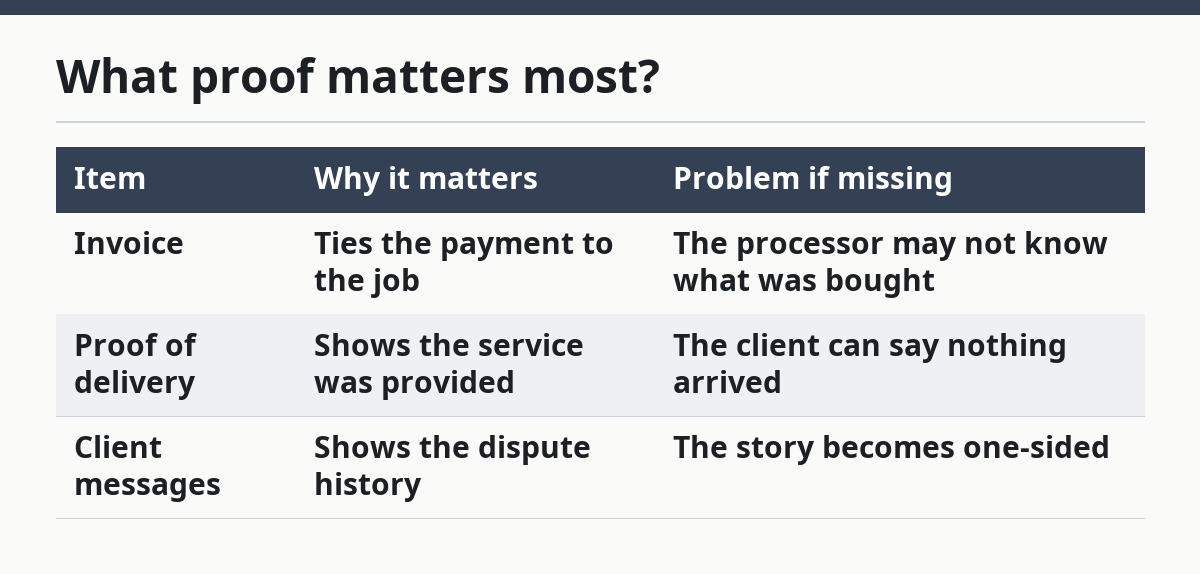
Because of that, the most useful proof is the proof that links the invoice to the service fulfillment. That usually means the signed scope, milestone approvals, delivery records, and messages showing that the client received the work or had a chance to review it.
A chargeback process can be strict about dates and payment descriptors, so the evidence should be easy to read. A 20-page archive is less helpful than a short set of records that shows the job, the handoff, and the client’s response. If you use screenshots, export them with timestamps intact rather than editing them into a document that hides the original context.
Specifically, a simple way to sort the file is to think in three columns:
| Item | Why it matters | Problem if missing |
|---|---|---|
| Invoice | Ties the payment to the job | The processor may not know what was bought |
| Proof of delivery | Shows the service was provided | The client can say nothing arrived |
| Client messages | Shows the dispute history | The story becomes one-sided |
If the dispute is about a service error rather than non-delivery, the proof should also show what was changed, corrected, or approved. A tiny typo is not the same as a failed project, but the processor and insurer may both want the same timeline to judge the difference.
When should I stop and get qualified help?
So you should stop relying on a do-it-yourself approach when the dispute starts touching legal rights, insurance notice timing, or a high-value payment. A chargeback can stay small on paper and still create a bigger problem if you miss a deadline or make a statement that later hurts your position.
The notice says “claim,” “demand,” or “formal dispute”: That can be more than a routine payment reversal — check your insurer’s notice rules and ask a qualified adviser how to report it.
The client threatens legal action within 7 days: The matter may be moving past card-network rules — preserve the record and get prompt guidance on how to respond.
The invoice is tied to a written scope with milestones: The facts may turn on contract wording and service fulfillment — do not guess at the meaning of the terms.
The amount is large enough to affect cash flow or payroll: The financial impact may be material — ask for help with the insurance side before you rely on a card-case outcome.
The dispute involves intellectual property, data access, or confidentiality: That can shift the issue outside a plain payment error — the policy terms may need a careful read.
You already missed a deadline to answer the processor: The card case may be weakened — focus on preserving insurance notice and getting advice on next steps.
This is the point where a general guide stops being enough. The chargeback process is procedural, but once the dispute threatens a legal claim or a possible coverage issue, the exact wording of your policy and your local rules matter more than generic advice.
What mistakes cost freelancers the most?
The most costly mistake is treating the chargeback as a simple billing annoyance and ignoring the insurance angle. That can leave you with a reversed payment and no clean notice to the insurer if the dispute later becomes a covered claim; if the facts are unclear, consult a professional.
Another common error is sending a long, emotional reply. A 3-paragraph complaint about the client may feel satisfying, but the processor and insurer both care more about dates, deliverables, and the invoice trail. Keep the language short, factual, and tied to the work.
A third mistake is mixing up the roles of the payment processor and the insurer. The processor decides whether the card payment stays reversed; the insurer decides whether the facts fit the cover. Those are different systems, and one cannot replace the other.
A fourth error is assuming the matter is “too small” to report. That can be a bad call if your policy has short notice rules or if the client’s complaint is already written down. Small disputes can still become formal ones if they sit unanswered for 30 days or more.
A fifth mistake is deleting messages after the dispute starts. Once the card case opens, the record matters more than ever, and a missing thread can look like a missing fact. Keep the original timestamps, file names, and invoice references intact.
When does the usual approach break down?
Therefore, the usual approach breaks down when the dispute is no longer just about payment reversal but about alleged failure to provide the service. In those cases, the standard “respond to the processor and wait” method can leave the insurance question unanswered for too long.
It also breaks down when more than one card payment is involved. If the client split a project into several invoices or made partial payments, a chargeback on one payment may not tell the full story. You may need to separate the records by invoice number, not by client name alone.
Another edge case is a subscription or recurring retainer. A chargeback on an automatic payment can involve authorization questions that are different from a one-off project invoice. The paperwork should show what the client agreed to, when the service period started, and what was delivered during that period.
Cross-border work is another exception. Country rules, processor deadlines, and insurance terms can differ, so a timeline that works in one place may not fit another. If the client is overseas, the safest move is to check the notice terms and the dispute deadline together, not separately.
If your freelance business is already dealing with several incidents, the hub page on freelancer insurance claims and incident response is the better place to step back and sort the larger pattern. This page is only for the chargeback piece and its possible insurance link.
How long does this usually take?
Overall, the timeline usually depends on the payment processor’s dispute process and the insurer’s notice rules, which are not the same thing. A chargeback can move on one schedule while an insurance review follows another, so a fast card result does not always settle the coverage question.
A good result looks like this: the invoice is matched to the payment, the service trail is clear, the client complaint is written down, and the insurer is told if the wording requires notice. Even if the card dispute is unresolved, the file should already show what happened and when.
A poor result looks like this: no saved notice, no service record, and no clear explanation of what the client says went wrong. That makes both the chargeback response and the insurance review harder, because the story has to be rebuilt from memory instead of documents.
The best sign that the process is on track is simple: every key fact can be matched to a date, a file, or a message. If one of those is missing, the gap is the next thing to fix.
Is a chargeback an insurance claim?
No, a chargeback is usually a payment dispute, not the claim itself. It can still matter to insurance if the facts behind the reversal suggest a covered allegation, such as failure to deliver or a professional error.
What records matter in a chargeback dispute?
The most useful records are the invoice, the service agreement or scope, proof of delivery, and client messages with timestamps. These records show what was promised, what was done, and what the client complained about, which is what both the processor and insurer usually need to see.
Should I tell my insurer about a chargeback?
Since the answer depends on the wording, tell your insurer if your policy requires prompt notice or if the dispute could turn into a claim. A chargeback alone may not be enough, but waiting can create a problem if the complaint later becomes formal. If the wording is unclear, ask a qualified adviser to review it for your own situation.
Drafted with AI; not yet reviewed by a person.
