
Last updated: November 23, 2026
Quick answer: binding freelance insurance coverage usually comes down to 3 items — a signed application, premium payment, and the right effective date. Binding freelance insurance coverage means giving the insurer the final go-ahead so the quote turns into active protection on the agreed effective date. In plain terms, the binding request is the step that moves your application from “priced” to “in force,” as long as the carrier still accepts the file. This is information, not financial advice; rates, rules, and timing vary by country and by insurer, so a qualified adviser should check your situation. For background on coverage terms and proof of insurance, see the NAIC and the Insurance Information Institute.
Key takeaways
- A quote is not active coverage until the binder or binding confirmation is issued.
- The binding request usually depends on a signed application, premium payment, and the right effective date.
- Missing paperwork can delay coverage by a day or more, even after you accept the quote.
- A certificate of insurance is proof for a third party; it is not the same thing as binding the policy.
- If the quote has a short deadline, an older loss history, or unusual contract wording, ask for help before you send the binding request.
Who this applies to

This applies to freelancers who already accepted an insurance quote and need coverage to start on a specific effective date. It assumes you have the quoted terms in hand, know the insurer’s requested documents, and can make the premium payment when asked. If the application has errors, the work is high-risk, or the policy terms do not match a client contract, stop and get qualified help before you bind. For related guidance on freelance general liability insurance and professional liability insurance, check those pages first if you are still comparing options.
The practical question is simple: do you have everything the insurer needs to issue the binder without a pause? In many cases, the answer depends on 3 things at once: a signed application, payment authorization, and any underwriting follow-up the carrier asks for. If one of those is missing, the file can sit unbound even after the quote is accepted.
A binding request is not the place to guess. If the policy needs a specialty endorsement, if there is a claim that has not been reported, or if the quote reflects information you are still unsure about, the safer move is to clarify first. A binder can be issued quickly, but speed does not fix an incorrect application. If the issue is complex, consult a licensed insurance professional or broker before you move ahead.
How do you bind freelance insurance coverage?
You bind freelance insurance coverage by sending the insurer the exact items it asks for, confirming the effective date, and authorizing premium payment so the binder can be issued. The usual sequence below is common, but the insurer’s instructions control the final order.
- Review the quote and binding instructions, then verify the named insured, business description, limits, and effective date before you reply.
- Sign the application, including any supplemental forms, and check that every blank the carrier requires is complete.
- Authorize the premium payment method the carrier accepts, such as card, ACH, or invoice instructions, and confirm the amount due matches the quote.
- Send the binding request with the signed application and any requested attachments so the underwriter has a complete file.
- Confirm that the carrier has accepted the requested effective date and that it matches the date you need coverage to begin.
- Request the binder in writing, and verify that it names the insured, policy type, effective date, and any special conditions.
- Check the proof of coverage once it arrives, and make sure the policy number, limits, and dates agree with the quote.
- Save the binder and payment receipt in one place, because a missing document can slow a later claim or client request.
The main thing to verify is that the binder reflects the same terms you accepted. If the effective date slips, the limits change, or the payment authorization fails, the bind is not clean yet. A problem usually shows up as a request for missing data, a changed premium, or a delay in issuing the confirmation. For a quick overview of policy timing, see business insurance basics.
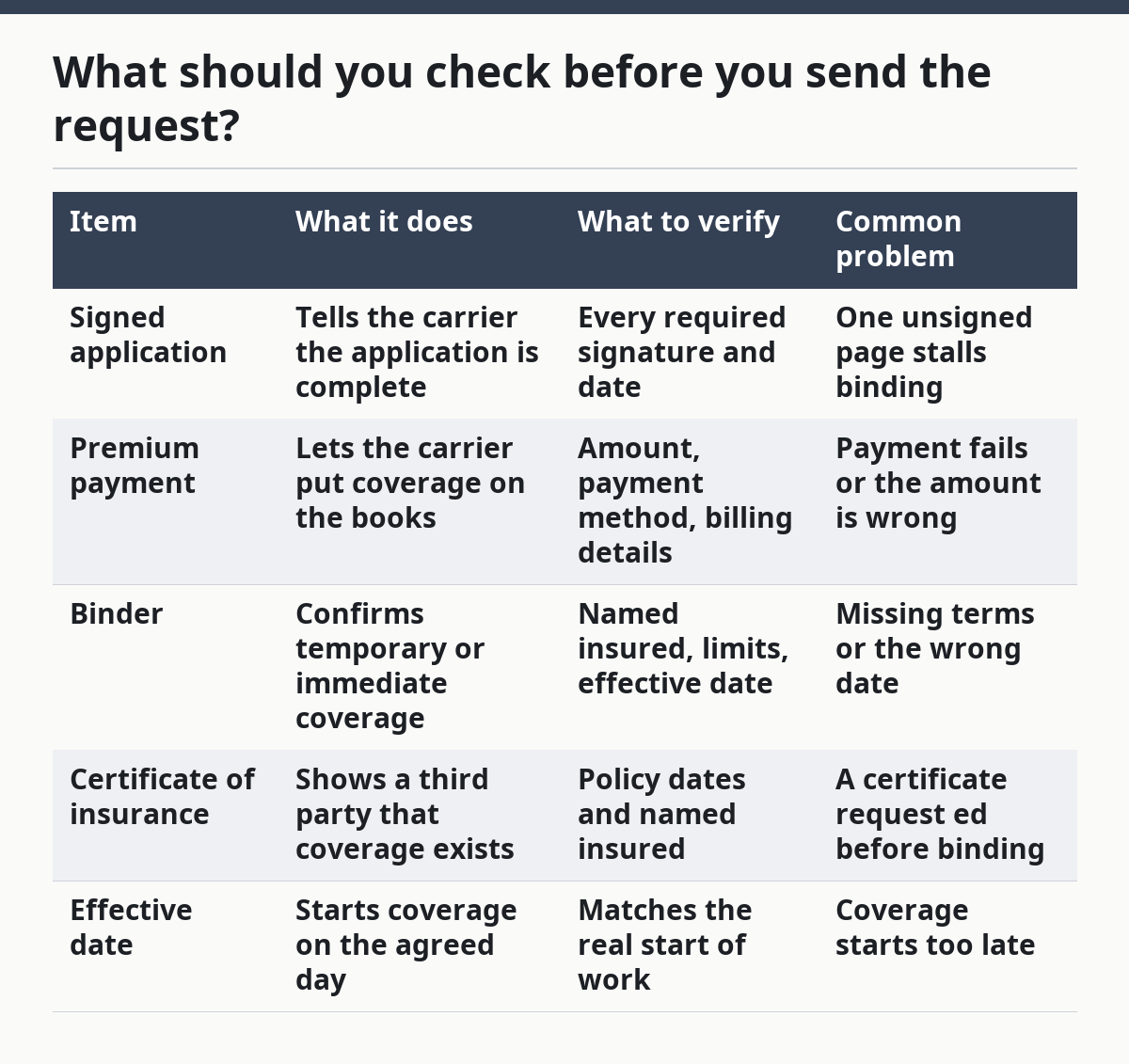
What should you check before you send the request?

You should check the application, payment, and date details before you send anything to the insurer. A 5-minute review now is cheaper than trying to fix a binding error after the coverage start date has passed.
The first item is the signed application. If the carrier needs signatures from the named insured, a business partner, or an authorized representative, missing one signature can hold the file. The second item is payment authority. If the insurer cannot process the premium, or if the card or bank details are incomplete, the binder may not be issued.
The third item is the effective date. This is the date coverage is intended to start, and it should match the day your risk actually begins, not just the day you emailed the quote acceptance. If a client contract needs proof of coverage before work starts, a one-day mismatch can matter even when the policy is otherwise fine.
| Item | What it does | What to verify | Common problem |
|---|---|---|---|
| Signed application | Tells the carrier the application is complete | Every required signature and date | One unsigned page stalls binding |
| Premium payment | Lets the carrier put coverage on the books | Amount, payment method, billing details | Payment fails or the amount is wrong |
| Binder | Confirms temporary or immediate coverage | Named insured, limits, effective date | Missing terms or the wrong date |
| Certificate of insurance | Shows a third party that coverage exists | Policy dates and named insured | A certificate requested before binding |
| Effective date | Starts coverage on the agreed day | Matches the real start of work | Coverage starts too late |
If one of these pieces is off, the insurer may still bind later, but not on the date you expected. That is why the best time to fix errors is before you hit send, or to confirm the correction with a licensed adviser if the file is sensitive. The policy folder should already contain the right 3 core items: application, payment, and date. For more on timing and proof, the NAIC glossary is a useful reference.
What can delay binding?
Binding can be delayed when the insurer still needs to verify something that changes the risk. The most common delays are simple, but the effect is the same: the binder does not come out until the carrier has what it needs.
A missing signature is one delay. A payment problem is another. So is an underwriting question about the work you do, the claims you have had, or the scope of services listed on the application. If the underwriter asks for 2 extra documents, the file is not ready until both arrive.
Another delay appears when the requested effective date is too close to the acceptance time. Some carriers can bind quickly; others need a business day or more to process the file. That gap matters when a client wants proof on short notice. The binding request should therefore go in as soon as the quote is accepted, not after you finish another task.
A change in facts can also slow things down. If you notice that the business name, mailing address, or description of freelance work is wrong after acceptance, report it before the binder is issued. A corrected file may still bind, but the insurer may reset the review. For similar timing issues, see how insurance quotes work.
When should you stop and ask for help?
You should stop and get qualified help when the binding request is no longer a simple handoff of completed documents. That is especially true in money and legal settings, where a wrong date or wrong term can affect contract rights.
Missing or uncertain coverage dates: This means the effective date is unclear or does not match your work start date — pause and confirm before sending the request, because backdating may not be available. If the date issue affects a contract, consult a licensed insurance professional or legal adviser before you proceed.
Application errors you cannot verify: This means the form contains facts you are not sure are correct — fix the application first, because the binder can reflect the wrong risk and create later trouble.
Special client contract terms: This means a client wants wording that goes beyond the standard policy — ask for qualified review, because the quote may not satisfy the contract even if it binds.
Unfinished underwriting questions: This means the carrier asked for more information about your services, claims, or business setup — answer those questions before you expect a binder, because silence usually delays issuance.
Payment uncertainty: This means the premium method may fail or the billing details do not match — correct the payment setup first, because a failed charge can stop binding on the spot.
Policy changes after acceptance: This means you want to alter limits, endorsements, or covered services after agreeing to the quote — recheck the file, because the binder should match the final terms, not an earlier version. If you are unsure whether the change requires a revised quote, ask the insurer or a broker before treating it as settled.
These are not cases for guesswork. If the file is straightforward and complete, binding can be routine. If it is not, the cost of a rushed request is often delay, confusion, or a binder that does not match what you thought you accepted.
What proof of coverage should you ask for?
You should ask for a binder or other written proof that shows the policy is active and names the key terms. A binder is the temporary or immediate evidence that coverage has been placed, while the policy declarations page is the formal record that follows later.
The proof should show at least the named insured, policy type, effective date, and any limits or special conditions the insurer attached. If the insurer issues a certificate of insurance later, treat it as evidence for a third party, not as proof that the coverage started by itself. If you are unsure whether the certificate matches the policy, consult a licensed insurance professional or the insurer and compare it to the policy documents. The certificate reflects the policy; it does not create the policy. For more context, the Insurance Information Institute explains what a certificate does and does not show.
Here is the useful distinction in 1 line: quote accepted means you agreed to the terms, binder issued means coverage is placed, and proof of coverage shows that placement in writing. If any of those 3 are missing, ask for the missing document rather than assuming the file is active.
For a cleaner paper trail, keep the acceptance email, the signed application, the payment receipt, and the binder together. If a problem comes up later, those 4 documents make it easier to show what was requested and when. That matters more than people expect when dates are close.
What mistakes slow the process down?
The most common mistakes are small administrative misses that turn into delay. A freelance policy often moves quickly, but only when the file is complete the first time.
Sending the quote acceptance without the signed application: This can leave the insurer without the authority to bind — the fix is to attach the completed form before you ask for the binder.
Skipping payment authorization: This can stop the policy from being placed even when the quote is accepted — the fix is to confirm the premium method and billing details in the same message.
Using the wrong effective date: This can create a gap between the work start date and the policy start date — the fix is to state the date clearly in writing and verify it in the binder.
Assuming a certificate is the same as bound coverage: This can leave you with paperwork that looks official but does not confirm the policy placement — the fix is to request the binder or policy confirmation.
Ignoring carrier follow-up questions: This can leave the file open and unbound for longer than expected — the fix is to answer the underwriting request the same day if possible.
Changing business facts after acceptance: This can trigger a re-review or revised premium — the fix is to report corrections before the binder is issued, not after.
The pattern here is simple: missing information costs time. A clean binding request uses the exact terms of the accepted quote and nothing more unless the carrier asks for it. That keeps the file on the shortest path from quote to coverage.
How long should binding take?
Binding should take only as long as the insurer needs to receive, review, and accept the completed file, which may be fast or may take longer depending on the carrier. In a straightforward case, the bottleneck is usually missing information, not the concept of binding itself.
The better question is whether the file is complete on the first pass. If the signed application, premium payment, and effective date all line up, the process can move with little friction. If one item is missing, the clock resets until that item arrives.
A good result looks like this: the binder shows the correct insured name, the right coverage type, the agreed effective date, and no surprise change in terms. A bad result is any binder that arrives with a date mismatch, a missing endorsement, or a premium that does not match the accepted quote. If that happens, stop and correct the file before you treat it as settled, and ask for professional review if the correction affects a contract or claim.
FAQ
What does it mean to bind insurance?
Binding insurance means the insurer agrees to put coverage in force from a stated effective date. It is the step that turns an accepted quote into active coverage, usually after the signed application and payment details are in place. The binder is the written proof that this placement has happened.
When does freelance insurance coverage start?
Freelance insurance coverage starts on the effective date shown in the binder or policy confirmation. That date may be the same day you accept the quote, but it does not have to be. The key point is that the written binder controls, so the date should be checked against the work you are about to do.
What do I need to send to bind a policy?
You usually need the signed application, payment authorization, and any documents the insurer requested during underwriting. In many cases, you also need to confirm the effective date in writing so the binder can be issued with the right start date. If the carrier asks for more, send those items before assuming coverage is active.
Drafted with AI; not yet reviewed by a person.
