

Last updated: November 27, 2026
Quick answer: freelancer liability insurance usually comes down to 2 cover types — public liability and professional indemnity. In this guide to Freelancer Liability Insurance — The Complete Guide: related questions, freelancer liability insurance is the policy that helps pay third-party claims if your work causes loss, damage, or injury. It matters most when a client says your advice, file, design, code, or missed deadline cost them money. This is information, not financial advice; a qualified adviser should be consulted for your own situation.
Key takeaways
- Liability cover for freelancers is about claims from other people, not your own lost income.
- The main question is not “Do I need insurance?” but “What claim could a client make against me?”
- Different work creates different risks: advice, media, code, data, and physical work do not fail in the same way.
- Policy wording matters as much as price, especially for exclusions, retroactive cover, and claim timing.
- If a contract demands a specific limit or certificate, the policy has to match that language exactly.
What does freelancer liability insurance actually cover?
Freelancer liability insurance covers claims made by other people when your work is alleged to have caused harm, loss, or injury. In practice, that usually means two broad types of cover: public liability and professional indemnity, with cyber or product liability sometimes added depending on the work.
Public liability deals with bodily injury or property damage. Professional indemnity, also called errors and omissions insurance in some markets, deals with mistakes in professional services, such as bad advice, a missed spec, or an error in a deliverable. A freelance photographer, web developer, consultant, copywriter, engineer, or designer can face different versions of these risks.
The key point is that liability insurance is not a blanket shield. It usually responds to third-party claims, not your own lost revenue, and it may not cover deliberate acts, criminal conduct, or every contract penalty. Countries, limits, and policy rules differ, so the wording on the policy schedule matters more than the label on the front page.
A common mistake is assuming that a general business policy automatically fits freelance work. A 1-page certificate may satisfy a client’s admin team, but the real question is whether the policy wording matches the work you actually do. For a plain-English overview of policy wording and exclusions, see the Association of British Insurers and CII guidance.
Which kind of freelancer needs which cover?
The right cover depends on the kind of mistake that could trigger a claim, not on the word “freelancer” itself. Different roles create different exposure.
| Type of freelance work | Main claim risk | Cover usually tied to it |
|---|---|---|
| Advice, strategy, reports | Client says the work caused financial loss | Professional indemnity |
| Client meetings, site visits, equipment use | Injury or property damage | Public liability |
| Handling client data, logins, files | Data breach or privacy-related loss | Cyber cover, sometimes PI |
| Selling a physical item or sample | Defect causes damage or injury | Product liability |
| Creative work with deadlines | Missed deadline or alleged IP issue | Professional indemnity, sometimes media liability |
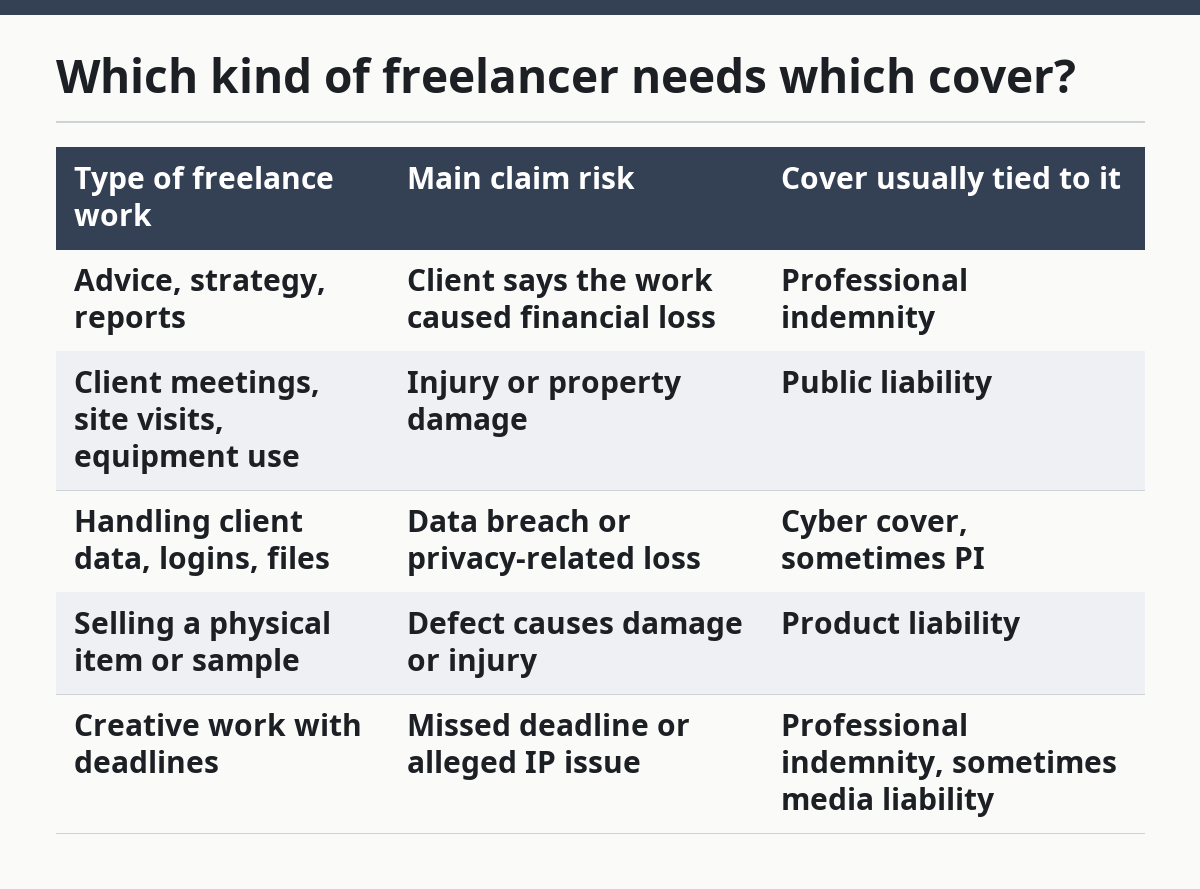
A freelance consultant who gives paid advice often needs a different policy shape from a freelance tradesperson who works in a client’s premises. A bookkeeper’s main danger is usually not a broken vase; it is a numbers error that triggers tax, cash-flow, or filing problems. A designer may need media liability if the work involves libel, defamation, or copyright claims, depending on the market.
The wrong cover is worse than no cover in one sense: it can create false confidence. If the policy only protects against injury on a premises visit, it will not help with a claim that your spreadsheet error cost a client 20% of a project budget; in that situation, the alleged loss is usually in the professional-indemnity territory, so check the wording and consult a professional adviser. The exact number is not the point; the type of loss is. For related cover types, see professional indemnity insurance and public liability insurance.
How do you choose cover step by step?
Choose cover by mapping your work, your contracts, and the biggest claim a client could bring. The process is practical, and it works best when the policy terms match the risk in writing.
- List every service you sell in the last 12 months. Write the services in plain language, such as “website copy,” “monthly bookkeeping,” or “on-site design advice.” Verify that the list is complete; if a service is missing, the quote may miss the real risk. A problem sign is a policy built around a narrower job than the one you actually do.
- Mark the claim type beside each service. For each line, decide whether the likely claim is bodily injury, property damage, data loss, or financial loss from a mistake. Verify that each service maps to the right policy bucket. If you cannot tell what claim the policy would answer, the cover is too vague.
- Check contract requirements before you ask for a quote. Look for named cover types, limits, jurisdiction clauses, and certificate wording. Verify whether the client wants professional indemnity, public liability, or both. A problem sign is a contract clause that says “must be maintained for 6 years” or “must name us as additional insured” and your policy cannot do that.
- Read the exclusions line by line. Search for exclusions on cyber events, IP claims, subcontractor work, bodily injury, pollution, fines, or deliberate acts. Verify that the excluded items are not central to your business. A problem sign is an exclusion that removes the exact risk you were trying to insure.
- Check the policy period and claim timing. Find out whether the policy is written on a claims-made basis, which usually means the claim must be made during the policy period, not just the event must happen then. Verify the retroactive date if one exists. A problem sign is a gap between when the work was done and when cover starts.
- Choose limits that fit the size of the claim, not the size of the premium. The limit is the most the insurer pays, before any deductible or excess. Verify whether one claim and all claims in the period share the same limit. A problem sign is a limit that looks fine until one claim eats most of it.
- Check the deductible or excess. This is the amount you must pay before the insurer pays. Verify that you can cover that amount from cash flow. A problem sign is an excess so high that a small claim becomes your own expense anyway.
- Ask how defense costs are handled. Some policies pay legal defense inside the limit; others pay it outside. Verify which structure applies, because a fast legal defense can reduce the money left for settlement. A problem sign is a policy where fees can consume the same limit you hoped would protect the claim.
A good result is simple: the services, the contract, and the policy language all point to the same risk. If they do not, the cheapest policy can become a costly mistake.
What should you check before a claim happens?
You should check the wording before a dispute starts, because wording is what controls payment. Once a claim lands, there is often less room to fix gaps.

Start with the named insured. The policy should match the legal entity that signs the client contract, whether that is a sole trader, partnership, or limited company. If the name is wrong, the claim can become a paperwork fight before it becomes a coverage issue.
Then check whether subcontractors are included. If you hand work to another freelancer, a policy may treat that as covered, excluded, or covered only with conditions; the safest route is to ask the insurer or a qualified broker to confirm how the wording applies to your setup. The same is true for overseas work, temporary client premises, and digital services delivered across borders. Country rules differ, so a policy sold in one market may not fit work done in another. For further guidance, see cyber insurance and business insurance.
Finally, look at the claims process. Many policies require prompt notice of a circumstance, not just a formal claim letter. That can matter if a client sends a complaint email 3 months before a lawyer’s letter arrives. Missed notice is a common reason for trouble.
When should a freelancer stop and get qualified help?
You should stop trying to self-match the policy when the contract, the industry, or the claim size creates a real coverage dispute. This is where a qualified insurance broker, solicitor, or accountant familiar with your market can help interpret the wording for your own facts.
Your contract requires a special clause: If a client wants “additional insured,” “waiver of subrogation,” or a specific jurisdiction, the policy may need endorsement wording — get help before signing. A mismatch can block the contract or leave you uninsured for the job.
You do regulated or specialist work: If your work touches law, tax, finance, health, or engineering, the claim risk can be larger than a standard freelancer policy. The consequence of a gap is not just a denied claim; it can be a direct hit to your business assets.
You sell into another country: Cross-border work can trigger different insurance rules, policy territory limits, and legal systems. The consequence of guessing wrong is a policy that looks valid at home but does not respond where the client is based.
You work through subcontractors: If others write, design, code, or visit sites on your behalf, their actions can fall outside a basic solo-freelancer setup. The consequence is a claim that lands on you even though the error came from someone else.
You already have a dispute: If a complaint email, letter of demand, or solicitor’s note has arrived, do not wait for the issue to “settle down.” The consequence of delay can be late notice, which may affect cover under a claims-made policy.
What mistakes do freelancers make most often?
The biggest mistakes are buying the wrong type of cover, not the wrong brand. One policy can be cheaper and still be useless for the claim you are most likely to face.
-
Thinking public liability covers advice errors. That can leave a consultant or designer exposed to a financial-loss claim. The better alternative is to check whether professional indemnity is needed for the services sold.
-
Ignoring the claims-made date. If the policy starts after the work was done, the claim may miss the window. The better alternative is to verify the retroactive date and keep continuity if you change insurers.
-
Buying based only on a client form. A client may ask for “insurance” without knowing the difference between cover types. The better alternative is to match the exact wording in the contract, not just the amount requested.
-
Leaving subcontractors out of the review. Their mistakes can become your claim. The better alternative is to ask whether their work is covered or needs separate treatment in the policy wording; if the wording is unclear, consult a qualified broker or adviser.
-
Forgetting defense costs. A claim can cost time and legal fees even when the final payout is small. The better alternative is to check whether defense costs reduce the policy limit.
-
Assuming one policy fits every service. A freelancer who writes, consults, and visits sites may need more than one risk bucket. The better alternative is to review each service line once a year, not once every 5 years.
How do claims usually work?
A liability claim usually starts with notice, then review, then defense, and only then settlement or denial. The sequence matters because late notice or missing documents can slow everything down.
The first step is to tell the insurer as soon as a claim or potential claim appears. That may include a demand letter, a complaint with a money value attached, or a written allegation that your work caused loss. The insurer then checks whether the event is inside the policy period, whether the named insured matches, and whether any exclusion applies.
If the claim is covered, the insurer may appoint defense counsel or ask for documents. Keep the original contract, statement of work, invoice, emails, file drafts, and change requests. Those records show what was agreed, what changed, and whether the loss came from your work or from something else.
A strong file can shorten the process; a thin file can turn a 2-page claim letter into a long dispute. Even when a claim is covered, the excess, the limit, and defense-cost wording still decide how much pressure the claim puts on your business. If notice is delayed, settlement may be harder, so tell the insurer promptly and keep every message in one place.
What about the edge cases?
Edge cases are the situations where standard freelancer guidance needs adjustment, often because the work is mixed or the risk is unusual. These cases are common enough that a generic policy summary often misses them.
If you work both on-site and remotely, public liability and professional indemnity may both matter. If you handle client data, cyber wording may need a closer look because a data incident can create legal and recovery costs that do not fit a pure PI description. If you sell templates, software, or downloads, ask whether the policy treats the item as a product, a media service, or something else, and get professional advice if the wording is unclear.
If you are new and have no prior policy, ask how the insurer treats past work. A 2024 project can still trigger a claim in 2026, and some policies only cover work done after a retroactive date, so a broker or qualified adviser should confirm the dates before you buy. If you change legal entity mid-year, the insured name must move with the business, not stay tied to an old trading name by accident.
One trade-off is simple: broader cover usually costs more and may carry more conditions. Narrower cover may be cheaper but can leave a real gap. The right choice depends on the work itself, not on a universal rule.
FAQ
Is freelancer liability insurance the same as professional indemnity?
No. Professional indemnity is one major type of liability cover, but it is not the whole category. Liability insurance can also include public liability, product liability, and sometimes cyber-related cover, depending on the insurer and the market.
Do freelancers need both public liability and professional indemnity?
Not always, but many service businesses need to think about both. Public liability matters when a person gets hurt or property is damaged, while professional indemnity matters when a client says your work caused financial loss. The right mix depends on whether your main risk is a site accident or a service error.
Does a client contract change what the policy must do?
Yes. A contract can require a specific cover type, a minimum limit, or a clause like additional insured status. If the policy does not match that wording, the contract can still be breached even if the premium is paid.
Will liability insurance cover every mistake I make?
No. Policies usually have exclusions, conditions, and limits. Deliberate acts, some contract disputes, prior-known issues, and risks outside the policy wording may not be covered, so the exact terms matter more than the headline label.
What is the main thing to check before buying?
Check whether the policy matches the kind of claim your work could cause. The fastest way to get this wrong is to focus only on price and ignore the exclusions, the claims basis, and the insured name on the schedule.
Drafted with AI; not yet reviewed by a person.
