

Last updated: November 22, 2026
Quick answer: most freelance bookkeepers need 2 core policies — professional liability insurance and cyber insurance. This article explains how bookkeeping insurance works, what those cover types usually respond to, and where the line is between bookkeeping, tax work, and higher-risk advisory work. This is information, not financial advice; for your own situation, speak with a qualified adviser.
Key takeaways
- The main risk in freelance bookkeeping is not broken equipment; it is a mistake, missed filing detail, or data breach.
- Professional liability insurance is the core cover for bookkeeping errors that lead to a client loss.
- Cyber insurance matters when your work touches passwords, bank records, tax files, or cloud accounting systems.
- The right mix depends on your contracts, the records you handle, and whether you stay within bookkeeping or drift into tax work.
- Insurance terms and pricing can vary by state, and some policies price risk using plans that reflect market trends rather than your own loss history.
What does bookkeeping insurance usually cover?

Bookkeeping insurance usually starts with professional liability insurance and may add cyber insurance if you store or transmit client financial records. Professional liability insurance is the cover that helps with claims that your work caused a financial loss through an error, omission, missed deadline, or similar mistake.
That matters because bookkeeping is built on trust with numbers. A transposed digit, a missed expense category, a duplicated payment, or a late filing can ripple into tax documents, cash flow, and client disputes. If your work includes cloud-based ledgers, payroll data, scanned receipts, or bank login details, cyber insurance becomes relevant because the exposure is about data handling, not just accounting accuracy.
A common mistake is assuming one policy does everything. It usually does not. Professional liability and cyber insurance address different problems, and a data leak does not behave like a spreadsheet error. A client may care about both, but the claim triggers are different. For guidance on cyber risk, see the National Association of Insurance Commissioners.
| Cover type | What it is for | What it is not for |
|---|---|---|
| Professional liability insurance | Alleged bookkeeping mistakes, omissions, and related financial harm | A stolen laptop by itself, unless another cover applies |
| Cyber insurance | Data theft, ransomware, compromised client financial records, and some breach response costs | Routine bookkeeping errors with no data incident |
| General liability insurance | Bodily injury or property damage tied to your business operations | Financial mistakes in ledgers or tax documents |
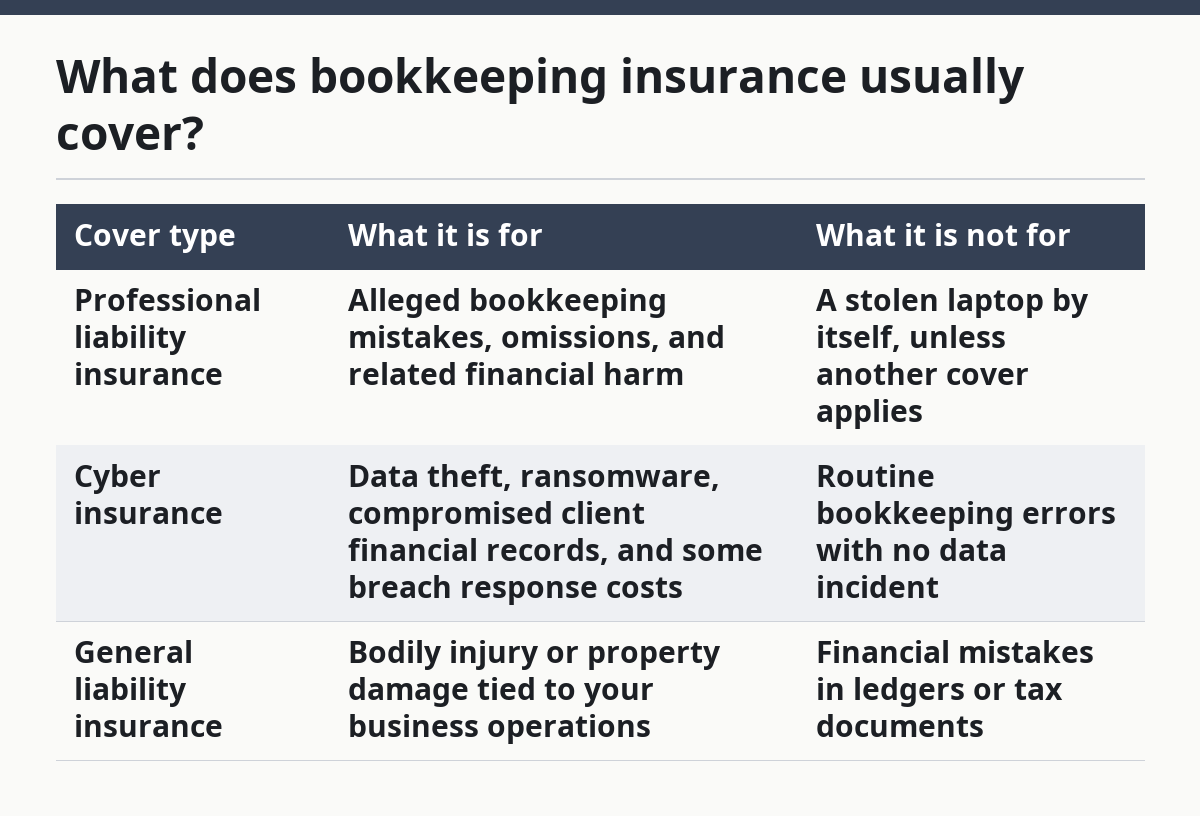
That table is the simple version. Real policies can add exclusions, endorsements, and limits that change the outcome of a claim, so the wording matters as much as the name on the policy.
Which risks matter most for a freelancer?
The main risks are financial errors, client record exposure, and work that crosses into tax work boundaries. For a freelance bookkeeper, that usually means three things: a wrong number, a lost or exposed file, or a task that the client thinks is tax advice when it is really bookkeeping support.
Financial errors include posting the wrong amount, coding a transaction to the wrong account, missing a reconciliation issue, or failing to spot a duplicate charge. Those mistakes can create tax documents that do not match the client’s records. Cyber risk shows up when you use shared folders, email attachments, cloud bookkeeping tools, or stored scans of sensitive files. Even a simple laptop or phone can carry client financial records.
Tax work boundaries matter because bookkeeping and tax work are not the same task, even if clients mix them up. A bookkeeper who prepares records for a tax return is doing support work; a person who begins giving tax recommendations moves into a different risk profile. That is where insurance wording and contract language need to line up.
A generic article gets this wrong by talking only about “accountants” in the abstract. A freelance bookkeeper’s real exposure is narrower in some places and wider in others. Narrower, because the job may not include full tax advice. Wider, because the work often touches many clients’ files in one place.
How do I choose the right cover?

Choose by mapping your work to the loss you could actually cause, then check the policy terms against that map. The practical method is simple, but it takes at least 7 steps.
- List every service you provide. Write down reconciliations, accounts payable, payroll support, receipt coding, and any tax-season help. Verify that each task is truly bookkeeping, not advisory work. A problem shows up when the list says “bookkeeping” but your client emails show tax recommendations.
- List every type of data you touch. Include client financial records, tax documents, bank statements, payroll files, and login credentials. Verify whether those files live in email, cloud storage, or a local device. A problem shows up when the file path is unclear, because that is where cyber exposure hides.
- Separate error risk from breach risk. A posting mistake belongs in professional liability insurance, while a stolen login or exposed file points toward cyber insurance. If you are unsure how a policy treats those events, consult a qualified insurance professional and check the policy wording. A problem shows up if you assume one policy responds to both.
- Check whether your contracts mention insurance. Read the clauses on liability, confidentiality, and records handling. Verify whether the contract asks for a certificate of insurance or a named type of cover. A problem shows up when your policy does not match the promise you made in writing.
- Review any tax-season tasks carefully. If you help organize tax documents, note exactly what you do and do not do. Verify that the wording in your client agreement stops short of tax advice unless that is part of your actual work. A problem shows up when tax guidance is implied but not covered.
- Compare policy wording, not just the category name. Two professional liability policies can treat bookkeeping mistakes differently, so it is wise to review exclusions, reporting rules, and how the insurer defines a claim with a qualified professional. A problem shows up when the cover sounds right but the wording excludes the loss you were worried about.
- Check the insurer itself. Independent rating agencies provide information on insurers’ financial viability, and companies are rated by agencies such as AM Best. Verify that the insurer has a rating source you can check. A problem shows up when no one can tell you how the insurer is evaluated.
- Match the policy structure to your business size. Retrospectively rated insurance sets premiums for large commercial accounts, according to Wikipedia, and the rating formula is guaranteed in the insurance contract. Verify whether your business is even in that kind of structure. A problem shows up when a small freelance practice is treated like a large commercial account, so ask a qualified adviser if the pricing model fits your business.
That process is about fit, not perfection. It also keeps you from buying a label instead of a policy. A policy that fits bookkeeping work should respond to the real job: records, errors, and sensitive data.
What if I only do bookkeeping, not tax advice?
Then your need usually centers on professional liability insurance and cyber insurance, not on the broader insurance stack that a tax advisory firm might need. If you only keep the books, your main exposure is a bookkeeping mistake or a data issue tied to client financial records.
That boundary matters because some clients speak loosely. They may ask for “help with taxes” when they really mean categorizing expenses or organizing tax documents. If you stay inside bookkeeping, your insurance needs should follow that scope. If you cross into tax recommendations, the risk profile changes, and the policy language should be reviewed with care.
This is where a generic answer fails. It is easy to say “accountants need insurance,” but a freelance bookkeeper is not a full-service accounting firm. The difference is not just branding. It changes what kinds of claims are most likely and which policy terms matter most.
A plain rule helps: if the work is about records, look at error and data cover; if the work is about advice, the professional exposure gets broader. The line can be blurred, so the service list in your own contract should be the guide.
When should I stop and get qualified help?
You should stop and get qualified help when the job stops being straightforward bookkeeping and starts affecting tax positions, large sums, or contract terms you do not understand. The right move then is not to guess; it is to have the policy and the client work reviewed by someone who handles insurance or legal issues for small businesses.
You are asked to advise on tax treatment: that is beyond basic bookkeeping — get qualified help before you accept the work or rely on a standard policy, and check the wording with a qualified adviser.
Your client wants you to store passwords or bank logins: that increases cyber exposure — check whether your current process and policy can handle it.
You handle payroll, tax documents, and bookkeeping in one workflow: the claims picture gets more mixed — ask for a review of how each task is classified.
A contract requires specific insurance wording or proof: a mismatch can become a business problem before any claim happens — have the contract and policy checked together.
You work across states or with clients in different states: prices and rating plans may vary by state, according to State Farm, so the same policy setup may not fit everywhere — confirm the structure where you operate.
That is not a warning to avoid the work. It is a signal that the simple version is no longer enough. A clean bookkeeping practice can be well covered, but only if the cover matches the actual work.
What mistakes do freelance bookkeepers make?
The most common mistake is buying cover for the title instead of the task. A person sees “business insurance” and assumes the policy fits bookkeeping, but the real issue is whether it responds to errors in client financial records and to cyber incidents.
Another mistake is ignoring data handling because the work looks “non-technical.” Emailing spreadsheets, sharing cloud folders, and holding tax documents on a laptop still creates cyber exposure. The consequence is a gap between how the work feels and how the policy reads.
A third mistake is assuming all mistakes are covered the same way. A typo in a ledger, a missed payment, and a breach of a client file are different events. The correct alternative is to separate professional liability from cyber insurance and check each trigger.
A fourth mistake is drifting into tax work without changing the paperwork. That can turn a narrow bookkeeping arrangement into something else in the eyes of a client or insurer. The alternative is to define the service in writing before tax season begins.
A fifth mistake is treating insurer strength as an afterthought. Insurance companies are rated by agencies such as AM Best, and independent rating agencies provide information about financial viability. The alternative is to check that the insurer itself can be evaluated, not just the policy title. See the AM Best rating guide.
How do insurers decide price and risk?
Insurers decide price using rating plans, and those plans may vary by state. That means two freelance bookkeepers doing similar work can see different pricing structures depending on where they operate, even before the insurer looks at the details of their services.
That pricing structure is not always based on your own loss history. According to Wikipedia, some rating structures reflect market trends rather than individual loss experience. That is why one freelance practice can be priced differently from another even if both keep the same kind of books.
Insurance can also be profitable in ways that are not obvious from the combined ratio alone. A company with a combined ratio over 100% may still be profitable because of investment earnings, according to Wikipedia. For a freelancer, the useful point is not the math itself but the reminder that insurer pricing and insurer stability are not the same question.
The practical takeaway is to read the policy like a tool, not a slogan. You want to know what work it covers, what it excludes, how claims are handled, and how the insurer is rated. That is the difference between a policy that sounds right and one that fits bookkeeping work.
What should I ask before I sign?
You should ask what the policy covers, what it excludes, and how it treats bookkeeping errors versus cyber incidents. Ask whether client financial records, tax documents, cloud tools, and email attachments are treated as part of the covered work. Ask whether the insurer’s rating can be checked through an independent rating agency such as AM Best.
Also ask how the policy handles a claim that starts as one thing and becomes another. A bookkeeping error can lead to a client dispute, then a records request, then a question about data exposure. The policy should make sense at each stage, not just on the brochure page.
If the answer is vague, that is a problem. A clear answer should tie the policy to the actual work, not to generic office risk.
Does bookkeeping insurance cover mistakes in reports?
It can, if the policy’s professional liability terms treat the report mistake as a covered bookkeeping error. The key issue is not the word “report” but whether the error caused a financial loss that the policy recognizes. A policy that covers bookkeeping mistakes may still exclude other kinds of advice or intentional acts.
Do freelance bookkeepers need cyber insurance?
Many do, because they handle client financial records, tax documents, and login details in digital form. Cyber insurance is the cover that addresses data exposure, not simple ledger mistakes. If your workflow stays entirely offline and never touches sensitive data, the need may be lower, but that is not the usual setup for freelance bookkeeping. For small-business guidance, the U.S. Small Business Administration is a useful starting point.
Is there insurance for accounting errors?
Yes, professional liability insurance is the standard cover people look at for accounting and bookkeeping errors. It is designed for claims tied to mistakes, omissions, or missed work that lead to financial harm. The exact response depends on the policy wording, so the name alone is not enough.
Drafted with AI; not yet reviewed by a person.
