

Last updated: November 22, 2026
Quick answer: most freelance translators need 1 core policy — professional liability insurance — plus cover that fits confidential documents, client deadlines, and the language service scope they actually handle. This is information, not financial advice; a qualified adviser should be consulted for the reader’s own situation because insurance rules, limits, and wording differ by country and change often. For plain-language background, see the NAIC guidance on professional liability insurance and the ICO guidance on personal data.
Key takeaways
- Translation work creates 2 main risks: accuracy mistakes and privacy problems.
- Professional liability insurance is the core policy for many translators because it addresses claims tied to translation errors.
- Confidential documents raise a separate issue: data handling, not just language quality.
- Client deadlines matter because late delivery can trigger a loss claim even when the translation itself is accurate.
- The right policy depends on the exact language service scope, including editing, localization, subtitling, and interpretation.
What insurance fits freelance translation work?

Therefore, freelance translators usually need professional liability insurance first, because translation errors can lead to a financial loss claim. That policy is often called professional indemnity insurance in some markets, and it is designed for work that fails to meet the promised professional standard.
A generic business policy may not be enough. Translation services often involve confidential documents, time-sensitive contracts, medical records, court papers, or marketing copy, and each of those can create a different type of claim. The issue is not only whether the words are correct, but whether a mistake, omission, or delay causes a client loss. For a broader overview, see the hub page on Freelancer insurance by work type — The Complete Guide.
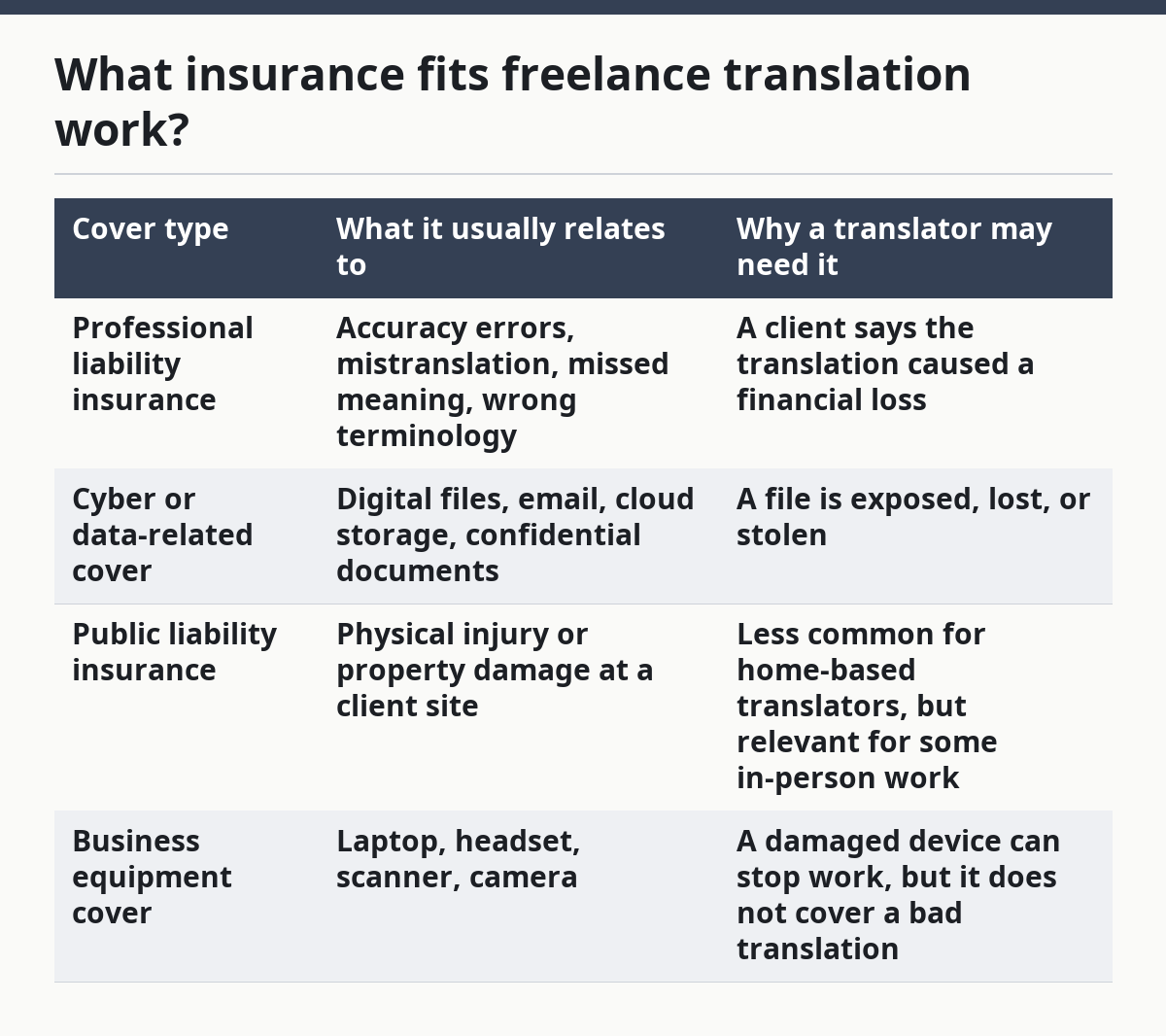
Here is the basic split in plain terms:
| Cover type | What it usually relates to | Why a translator may need it |
|---|---|---|
| Professional liability insurance | Accuracy errors, mistranslation, missed meaning, wrong terminology | A client says the translation caused a financial loss |
| Cyber or data-related cover | Digital files, email, cloud storage, confidential documents | A file is exposed, lost, or stolen |
| Public liability insurance | Physical injury or property damage at a client site | Less common for home-based translators, but relevant for some in-person work |
| Business equipment cover | Laptop, headset, scanner, camera | A damaged device can stop work, but it does not cover a bad translation |
In particular, this is where the scope matters. A translator who only translates text has a different risk profile from one who also localizes software, manages glossary terms, or handles confidential files under an nda. The policy should match the actual service, not the title on a business card. If the business also offers editing or interpreting, see professional liability insurance basics and cyber insurance for freelancers.
How does translation insurance work in practice?
In practice, translation insurance works by responding to a claim against the freelancer, not by guaranteeing that no mistake happens. The insurer looks at the policy wording, the work performed, the alleged loss, and whether the claim falls inside the covered language service scope.
A practical way to think about it is this: if a client says a mistranslated clause changed the meaning of a contract, professional liability insurance may be the policy that answers that claim. If a laptop with confidential documents is stolen, data-related cover may be the policy that matters. If a deadline is missed because the job was accepted without enough time, the policy wording decides whether that delay is covered.
The mechanism depends on 5 moving parts:
- The claim type. Some claims are about accuracy errors, some are about disclosure, and some are about missed deadlines.
- The service description. Translating legal text is not the same as translating ads or subtitles.
- The duty to notify. Many policies require prompt notice once a problem is known.
- The proof trail. Email instructions, scope notes, and version history often matter.
- The exclusions. Policies can exclude known issues, deliberate acts, or work outside the declared activity.
A good policy also respects the language service scope. If the freelancer starts offering proofreading, localization, transcreation, or glossary management, those services should not sit outside the cover by accident. That mismatch is a common reason for a later dispute. For related reading, see how to choose business insurance for freelancers and what professional indemnity insurance covers.
The shortest honest rule is this: the insurance should follow the work, not the other way around.
What should be checked before choosing a policy?
The main check is whether the wording matches the translator’s real files, deadlines, and client contracts. That means looking at the policy form line by line, not just the headline label.
Start with the type of work. If the translator handles confidential documents, ask how privacy, data loss, and third-party access are treated, and consult a qualified insurance professional if the wording is unclear. If the translator works under nda terms, check whether the policy has any exclusion for confidentiality breaches or whether those claims are treated separately from translation errors. The ICO’s guidance on personal data is a useful reference point, but the policy wording still controls the claim.
Then check the time pressure in the work itself. A client deadline can create a loss even when the translation is technically sound, so the policy should be read for delay-related exclusions. Many translators assume every bad outcome is an “error” claim, but a missed delivery date is often treated differently from a mistranslated sentence. If the contract is strict, ask a qualified adviser how the policy handles delay risk before binding cover.
The next check is the project mix. Legal, medical, financial, technical, and marketing translation are not identical risk buckets. A contract clause can carry a very different exposure from a product brochure. The broader the language service scope, the more careful the policy match needs to be.
A simple review list helps:
- Confirm the exact services named on the schedule.
- Check whether translation, editing, localization, and proofreading are all listed.
- Look for any confidentiality or data exclusions.
- Check whether subcontracted work is covered.
- Read the claims notification rule.
- Check whether work done before the policy start date is excluded.
- Ask how deadlines, omissions, and inaccurate terminology are treated, and get professional advice if anything is unclear.
The National Association of Insurance Commissioners has plain-language consumer material on professional liability concepts, and the UK Information Commissioner’s Office has guidance on personal data handling. Those bodies are useful reference points for understanding risk, even though the policy wording still controls the claim.
What insurance do freelance translators need for confidential work?
Therefore, freelance translators working with confidential documents usually need professional liability insurance plus a close look at data or cyber cover. Confidentiality problems are not the same as translation errors, and a policy that handles one may not handle the other.
This matters most when the files include personal data, trade secrets, contract drafts, medical records, or court material. A translator may handle dozens of documents in a week, but one exposed email chain can create a loss that has nothing to do with the quality of the translation itself. That is why an nda is not enough on its own. An nda is a contract term; insurance is a financial backstop for certain covered claims.
The key question is what the policy says about electronic storage and transfer. If files are kept on a laptop, a cloud drive, or email attachments, the translator should know whether unauthorized access, accidental forwarding, or device theft is addressed. If the work is entirely offline, the exposure is smaller, but not zero.
There is also a scope issue. A translator who also formats, redacts, or manages source files is doing more than word conversion. That broader service set changes the risk. The more steps involved in handling confidential documents, the more carefully the policy has to be matched to the business. See also cyber insurance for freelancers and data protection for small businesses.
The safest reading habit is to treat the confidentiality clause, the exclusions, and the service description as one unit, not as separate promises. If those three do not fit together, the policy may look fine and still miss the real risk.
When does the standard approach not fit?
So the standard approach does not fit when the translator’s work is unusually regulated, unusually time-sensitive, or outside ordinary text translation. In those cases, a general policy may leave a gap that only becomes visible after a claim.
Legal translation for court use: the stakes are higher and the wording may affect legal rights — use a policy that clearly names legal translation or get qualified advice before relying on a generic form.
Medical or clinical documents: the content can affect health decisions — confirm whether medical translation is inside the declared language service scope, because some policies narrow the field.
High-volume agency work with strict client deadlines: delay risk is real — check whether late delivery is treated as a covered professional error or an excluded contractual breach, and ask a qualified adviser if needed.
Subcontracting to other translators: responsibility can shift without warning — ask whether the policy covers work done by subcontractors and whether the translator must supervise them.
Software localization or transcreation: these are not plain-text jobs — a policy written only for translation may not fit file handling, version control, or marketing claims.
Physical work on client premises 2 or 3 days a week: the risk is broader than language work — public liability may matter in addition to professional liability insurance.
These are the moments when a quick yes-or-no answer is not enough. The policy wording, the client contract, and the actual service menu need to line up.
What mistakes do translators make with insurance?
The most common mistake is assuming one policy labeled “business” covers every translation risk. That can leave a gap in claims tied to accuracy errors, confidential documents, or missed deadlines. The better alternative is to check whether professional liability insurance is actually named and whether the service scope matches the work.
A second mistake is listing only “translation” when the business also does editing, localization, terminology work, or formatting. The consequence is a scope mismatch, and that can make a real claim harder to defend. The fix is to describe the work honestly and broadly enough to match what gets billed.
A third mistake is ignoring confidentiality because an nda already exists. The consequence is that contract language and insurance language get confused. An nda can assign duties, but it does not automatically pay a claim. The better approach is to ask how confidential documents and data handling are treated under the policy.
A fourth mistake is overlooking deadlines. A translator may believe only wording errors matter, while the client’s loss comes from late delivery. The correct approach is to read for delay exclusions and to understand whether the policy treats a missed client deadline as a covered event or a contract dispute. For a policy check, compare the wording with professional liability insurance basics and freelancer contract essentials.
A fifth mistake is not keeping a paper trail. If instructions, glossary terms, and file versions are not recorded, a later claim is harder to explain. The alternative is to keep clear project records, especially for jobs that involve technical terms or multiple revisions.
What if the translation job changes mid-project?
Overall, the insurance should be checked again if the job changes from simple text translation to something broader. A project that starts as a 2-page brochure can become a 40-page website localization job with confidential attachments and a hard deadline, and that change matters.
This is the edge case many freelancers miss. The policy may have been written for a narrow service, but the actual assignment expands. If the work moves into legal, medical, or financial material, the risk profile changes with it. If the client adds confidential annexes or asks for overnight delivery, the exposure also changes.
The correct response is not to guess. Review the policy wording, compare it to the new work, and check whether the language service scope still fits. If the work now sits outside the original description, the sensible step is to get qualified help from an insurance professional who can read the wording against the project terms.
That is the practical rule: when the job changes, the cover should be checked before the next file is sent.
Do translators need professional liability insurance?
Yes, many freelance translators do need professional liability insurance because translation errors can create a client loss. The need is strongest when the work involves legal, medical, technical, or financial material, or when the client relies on the translation for a business decision.
The exact answer depends on the translator’s country, contract terms, and service scope. A qualified insurance adviser should be consulted for the reader’s own situation, because policy names and legal duties differ by market.
Does insurance cover translation errors?
Often yes, if the policy includes professional liability insurance and the error falls within the stated service scope. That can include a mistranslated term, a missed line, or a wrong nuance that causes a covered loss.
It does not mean every bad outcome is covered. Some policies exclude known issues, late notice, contract penalties, or work outside the declared language service scope.
What if a translator works with confidential material?
The translator should look for both professional liability insurance and cover that addresses data or privacy risk. Confidential documents create exposure through loss, theft, accidental disclosure, or unauthorized access, and an nda does not remove that risk.
The policy wording should be checked for confidentiality exclusions, electronic file handling, and subcontractor rules. If the work involves sensitive material, getting qualified advice before binding cover is the prudent step.
Sources worth checking
The National Association of Insurance Commissioners explains professional liability insurance concepts for consumers, and the UK Information Commissioner’s Office explains the handling of personal data. Those sources help frame the risk, but they do not replace the policy wording or country-specific advice.
The bottom line is simple: freelance translators usually need translation insurance built around professional liability insurance, with careful attention to confidential documents, client deadlines, and the exact language service scope.
Drafted with AI; not yet reviewed by a person.
