
Last updated: November 26, 2026
Quick answer: To insure freelance work as a seasonal or project-based business, use a 7-step setup: match the policy term to your work dates, separate general liability from professional liability, check business personal property, request certificates before clients ask, and keep renewal dates continuous through slow months.
How to Insure Freelance Work as a Seasonal or Project-Based Business works best when the policy dates match the dates you are actually working, then stay active through gaps if your contracts, client forms, or liability exposure do not truly stop. For a seasonal freelance business insurance setup, the core job is to align policy term, project start and end dates, and proof of active business with the way your work really runs. This is information, not financial advice, and you should consult a qualified adviser for your own situation.
Key takeaways
- Match the policy term to the work cycle, not to a calendar habit.
- General liability covers third-party injury or property damage; professional liability covers work errors and missed promises.
- A certificate of insurance often matters before a client will let work start.
- Inactive months can still leave exposure if claims are made after a project ends.
- Business personal property matters when tools, computers, or gear move between sites.
Who this applies to
This applies to freelancers whose work comes in bursts, by contract, by season, or by project, such as designers, writers, photographers, consultants, and crew-based solo operators. It assumes you already know the kind of work you do, when your projects usually start and end, and whether clients ask for proof of insurance before a contract begins. For a broad map of solo-business coverage, the hub on freelance insurance for solo businesses is the right place to start.
It does not fit every case. If your income pattern is irregular in a way that makes it hard to show an active business at all, or if you are trying to solve a new-launch issue rather than a seasonal cycle, this page is not the right match. The same is true if you need help with billing setup or automatic renewal mechanics; those are separate problems.
A seasonal setup also assumes you can point to real work windows. If you have a 3-month busy season, a 6-week campaign, or repeated project blocks with clear start and end dates, insurance can be timed around those facts. If your work is truly on and off without a pattern, the policy decision changes.
How do you set up coverage for seasonal work?
You set it up by mapping your work dates first, then choosing policy terms and limits that cover the work window and the claims window. The point is not to buy the longest policy by default, but to make sure the insurance responds when a client, venue, or third party brings a claim after a project starts or ends.
-
List your project dates on one calendar for the next 12 months and mark each contract’s start date, end date, and any gap of 30 days or more. Verify that every paid job has a date range. A problem sign is a vague “summer season” with no contract dates, because the insurer may not be able to see the exposure window clearly.
-
Identify the policy term you need, such as a 6-month, 12-month, or project-tied term if your insurer offers one. Verify whether the policy renews on a fixed date or follows an annual cycle. A problem sign is a term that ends before your busiest work month, which can leave you uninsured during active jobs.
-
Separate general liability from professional liability before you apply. General liability is for third-party bodily injury or property damage; professional liability is for mistakes, missed deadlines, bad advice, or a work product that causes financial harm. Verify that the coverage type matches the risk in the contract. A problem sign is assuming one policy does both jobs in the same way.
-
Check business personal property coverage for tools, laptops, cameras, or other owned gear used on projects. Verify the covered location and whether items used off-site are included. A problem sign is gear that travels to client sites but is only protected while sitting at your home address.
-
Request a certificate of insurance before the client asks for it if the contract requires proof of active coverage. Verify the client name, policy dates, and coverage types on the certificate. A problem sign is a certificate with a date mismatch, because that can delay the project start.
-
Review inactive periods and ask how claims are handled after a project ends. If the policy is claims-made or occurrence-based, consult the insurer or a qualified adviser because that changes how past work is treated. A problem sign is ending coverage the same day a project finishes when a claim could appear later. See the NAIC’s consumer guidance on insurance policy basics and claims handling: NAIC insurance basics.
-
Set renewal timing so the next term begins before the old one ends, especially if your season restarts at the same time each year. Verify the renewal date at least 30 days before the gap you want to avoid. A problem sign is relying on memory during a slow month, because a missed renewal can break continuity.
-
Confirm proof of active business with records that support the work cycle, such as signed contracts, invoices, or a current client agreement. If the timing is unclear, the insurer may ask for more proof or may treat the risk differently, so consult the insurer or a qualified adviser and answer with exact records. A problem sign is answering with loose estimates when the policy application asks for dates and activity.
For general background on how insurance contracts and proof of coverage work, the National Association of Insurance Commissioners and the U.S. Small Business Administration both publish plain-language guidance.
What changes during slow months?
Slow months change the risk, but they do not always remove the need for coverage. If your business is idle for 2 months but your gear is still stored, your past work can still produce claims, and a client can still ask for proof of insurance tied to a later project.
The main trade-off is cost versus continuity. A shorter policy may look efficient if you have only a few projects, but gaps can be a problem if a claim is filed after the job ends or if a new contract starts sooner than expected. That is why policy term matters more for seasonal work than for a steady year-round business.
| Coverage approach | Where it fits | Main advantage | Main drawback |
|---|---|---|---|
| Annual policy | Repeated seasonal work with predictable cycles | Easier continuity across busy and slow months | Can feel oversized during long gaps |
| Short-term policy | One project or a single defined season | Matches a narrow work window | Gaps can be hard to manage |
| Ongoing policy with scheduled renewal | Freelancers with repeated project bursts | Better for returning clients and repeat dates | Needs closer calendar tracking |
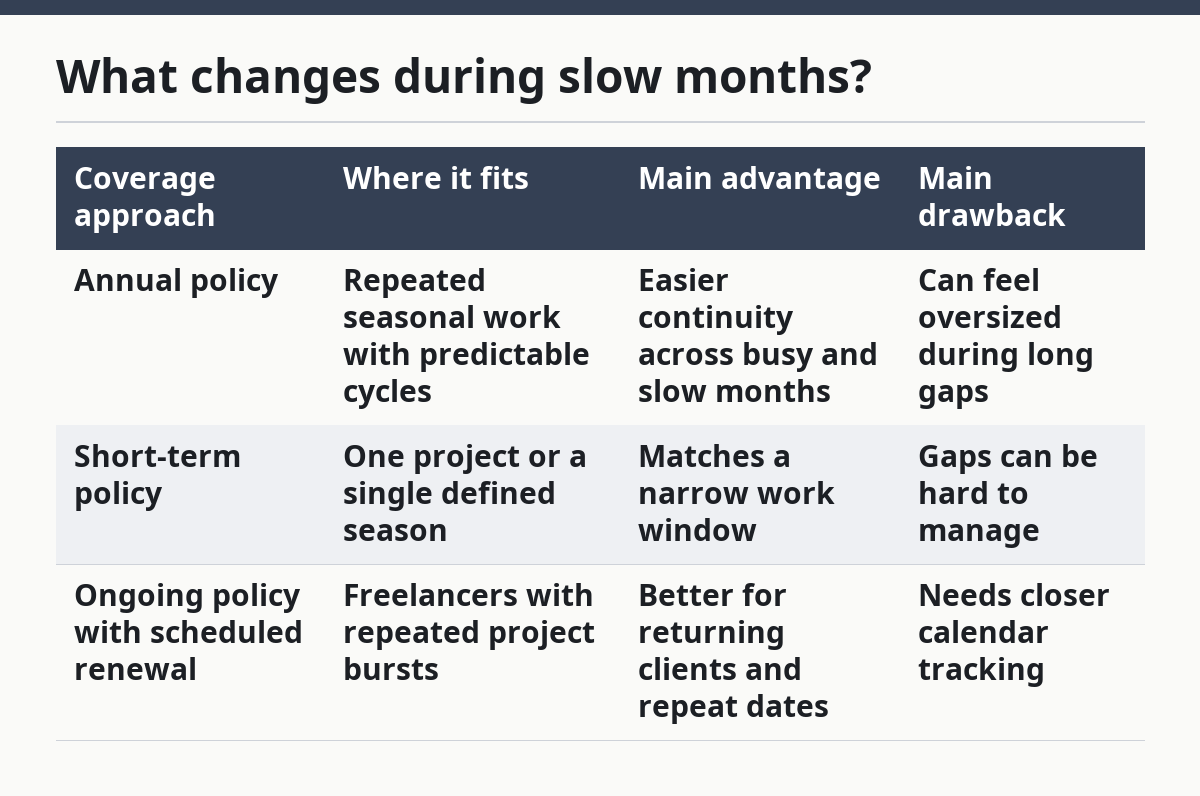
The right choice depends on how often the work returns and whether the policy must satisfy a client before each project. A 12-month policy can be easier to keep continuous, while a shorter term can fit a tightly defined 6-week or 3-month assignment. The wrong choice is the one that leaves no active policy when a contract requires one. For a broader planning framework, see the guide to business liability insurance.
What should you check before a project starts?
You should check the contract, the dates, the proof of insurance, and the risk type before any billable work begins. That check is what keeps a project from starting under the wrong policy term or with the wrong coverage type attached.
Start with the contract’s insurance clause. If the client asks for general liability, professional liability, or both, match the certificate to the words on the page rather than guessing from past jobs. A 1-page certificate that lists the wrong dates can fail even if the policy itself is active.
Then check the project schedule. If a job runs from one month into the next, make sure the policy term spans both dates and does not end in the middle of the assignment. A one-day gap can matter if the claim lands on that day.
Finally, check your gear and work location. If you carry business personal property to a studio, a set, or a client site, confirm where it is protected and whether the policy expects a fixed address. If the answer is unclear, that is a sign to ask for the exact wording before the project starts. For more on certificates, see certificate of insurance basics.
When should you stop and get qualified help?
You should stop using a standard seasonal setup when the policy question turns into a contract, tax, or claims problem that depends on exact wording. On a money topic, that means the mechanism matters more than the label.
The client requires a specific coverage form: It may mean general liability, professional liability, or another form is named in the contract — get qualified help before signing, because the wrong certificate can stall the job.
Your project crosses an inactive period: It may mean the claim could arise after work ends — confirm how the policy handles claims after the finish date before you let coverage lapse.
Your insurer asks for proof of active business: It may mean they want records that match a real seasonal cycle — use exact contracts and invoices, not estimates.
Your tools move between sites: It may mean business personal property needs off-site attention — check whether the policy covers items away from your home or studio.
Your renewal date falls inside a busy project window: It may mean continuity is at risk — fix the timing before the project starts, not after. You can also compare policy timing with the page on business insurance renewal.
What mistakes do seasonal freelancers make?
They usually make the same few mistakes, and each one has a practical cost. The issue is rarely that they bought “the wrong insurance” in the abstract; it is that the dates, coverage type, or proof do not match the work.
First, people treat seasonal work like it is the same as a year-round business and ignore the policy term. That can leave a gap between jobs, which is a problem if the next client wants proof before work starts. The better move is to tie the policy to the project calendar.
Second, people confuse general liability with professional liability. That matters because injury or property damage is not the same risk as bad advice, missed deliverables, or a flawed design. The fix is to read the contract language and line it up with the coverage type.
Third, people forget about business personal property once the busy season ends. A laptop, camera, or printer can still be exposed during storage or transport, even if the business is quiet for 3 months. The fix is to check where the item is covered, not only whether it is owned.
Fourth, people assume a certificate of insurance is just paperwork. It is not; many clients use it as the gatekeeper for project start. The better alternative is to request it early and confirm the names and dates before sending it.
How do insurers view seasonal freelance income?
Insurers usually care more about documented activity than about whether income is smooth every month. If your work comes in 2 or 3 clear seasons, that can still look like a real business, as long as your dates, contracts, and project flow make sense.
What tends to matter is whether your policy request matches your actual pattern. A freelancer with a winter campaign, a summer event season, or recurring project blocks can often explain the cycle in plain terms. A vague answer like “I do some work now and then” is weaker than a schedule with named clients, start dates, and end dates.
This is where proof of active business helps. A current contract, recent invoice, or signed project agreement can show that the business is live, even if it is not busy every month. The exact evidence an insurer wants can change by country and by carrier, so the request should be answered as written rather than with a general statement.
What does a good seasonal setup look like?
A good seasonal setup has no surprise gaps, no mismatch between the contract and the certificate, and no coverage type that leaves the main risk uncovered. It also makes renewal dates and project dates easy to compare on one page.
That usually means the policy term begins before the first job starts and ends after the last likely claim window, not merely after the last invoice. It means the certificate of insurance is ready when a client asks for it, and it means business personal property has been checked for off-site use if the work moves around.
The best sign is that the next project already fits the insurance without a last-minute rewrite of dates or limits. The strongest setup avoids having to rebuild coverage from scratch every season because the dates, limits, or policy type never matched the business model in the first place. For additional context, see professional liability insurance and general liability insurance.
Do I need insurance when I am between projects?
You may still need coverage when you are between projects if claims can arise from past work or if a new client can ask for proof before the next job starts. The main question is not whether you are busy this week, but whether the policy still matches the exposure window and the contract timeline.
Should I keep a policy active during slow months?
You may want to keep it active if the next project is likely to start soon, if clients expect continuous proof, or if past work could still trigger a claim. A gap can create a continuity problem even when there is no current assignment. The right answer depends on your dates, your contract terms, and the type of coverage.
How do insurers view seasonal freelance income?
They usually look for a real pattern, not a perfect monthly income stream. Seasonal income can make sense if your contracts, invoices, and project dates show an active business cycle. If the timing is unclear, the insurer may ask for more proof or may treat the risk differently based on the application details.
Drafted with AI; not yet reviewed by a person.
