

Last updated: November 21, 2026
Quick Answer: Most freelancers can start the underwriting process with 1 clear service description, and many policies are written for a 12-month term. Freelancer insurance underwriting decides whether you can get a policy, what it covers, and what conditions come with it. This guide to Freelancer Insurance Underwriting and Eligibility — The Complete Guide explains how eligibility usually comes down to the kind of work you do, the claims or incidents in your past, the contracts you sign, and the country where you operate. This is information, not financial advice, and a qualified adviser should be consulted for your own situation.
Key takeaways
- Underwriting is the insurer’s risk check before it offers terms.
- Your line of work matters more than your job title.
- A clean claims history helps, but a short work history may still allow cover in some cases.
- Contracts can change eligibility if you promise extra liability.
- The fastest way to avoid delays is usually to gather your work details before you apply.
What does underwriting check?

Underwriting checks whether your freelance work fits the insurer’s rules and what risk it brings. If your work is low-risk on paper, the process is usually simpler; if you work with higher-stakes advice, client data, or physical jobs, the insurer may ask for more detail or decline part of the risk. Most policies are written for a 12-month term, but the decision starts long before the policy year begins.
The underwriter usually looks at a short list of items: what you do, who your clients are, where you work, whether you use subcontractors, and whether you have made claims before. If you are a designer, writer, developer, consultant, photographer, or marketer, the insurer may treat you very differently from a freelancer who gives medical advice, handles money for clients, or enters homes and job sites. For freelancers in those fields, it is sensible to consult a qualified insurance professional and check a source such as the Financial Conduct Authority or the National Association of Insurance Commissioners before you assume a standard policy will fit. The title “freelancer” is not the real test. The task list is.
A generic article often misses the point that underwriting is not only about whether you are “allowed” to buy a policy. It also decides the terms of the policy. That can mean exclusions, limits, deductibles, or a request for more documents before the insurer issues cover. Two freelancers with the same annual revenue can get different outcomes if one signs broad indemnity clauses and the other does not.
If you want to see how a regulator frames consumer insurance and complaints, the UK’s Financial Conduct Authority has plain-language guidance on insurance and the Association of British Insurers also publishes consumer material on business cover. If you are in the United States, the National Association of Insurance Commissioners is a useful starting point for general insurance terms and consumer guidance. Those bodies do not set your price, but they help show how insurers think about risk.
A simple way to think about underwriting is this: the insurer is not asking, “Are you a freelancer?” It is asking, “What exactly can go wrong if this person is doing this work for this client?” That is why a freelance illustrator and a freelance bookkeeper can face very different questions.
Quick check: If your work touches client money, private data, physical property, or regulated advice, expect underwriting to ask for more than a basic application form.
Am I eligible if I’m a new freelancer?
Yes, many new freelancers can still be eligible, but the underwriter may ask more questions and rely less on your history. If you have only been freelancing for a few months, the insurer may focus on your past employment, prior professional cover, qualifications, and the type of work you plan to do. A short freelance track record is not the same as an automatic refusal.
This is where people often get the answer wrong. They assume a new business must be “too small” or “too new” for cover. In practice, the insurer may care more about the nature of your work than the age of your business. A one-person studio doing low-risk creative work can look easier to insure than an established freelancer taking on high-liability contracts.
If your profile is thin, the insurer may ask for details such as prior experience, website samples, client contracts, job descriptions, or proof of training. Some will also want to know whether you are working alone or using subcontractors. If you are using a platform marketplace, the insurer may still underwrite you as an independent contractor, not as a platform worker, because the risk sits with your business.
Here is the practical path if you are new and want to improve eligibility without guessing:
- Write down your exact freelance services in one sentence, not a vague label.
- List the kinds of clients you serve, such as private individuals, agencies, or businesses.
- Gather proof of relevant experience, such as prior employment, certificates, or a portfolio.
- Check whether your contracts ask you to take on extra liability beyond the work itself.
- Note whether you handle personal data, client funds, physical property, or access to premises.
- Ask for a quote only after your work description matches what you actually do.
A common mistake is trying to make the business sound simpler than it is. That can backfire later if a claim is reviewed and the insurer says the application left out a service line. If you are a new freelancer with a narrow service offer, the underwriter may be perfectly willing to quote you. If you are a new freelancer with a broad and changing offer, expect more questions.
You also need to watch for timing. Some policies begin with a waiting period for prior acts or specific endorsements, and some only cover claims made while the policy is active. That means the date you apply and the date you start trading can matter. The rules differ by country and insurer, so do not assume one setup works everywhere.
Quick check: If you have less than a year of freelance history, your application is usually judged on work type, training, and contract terms more than on revenue alone.
What changes the answer most?

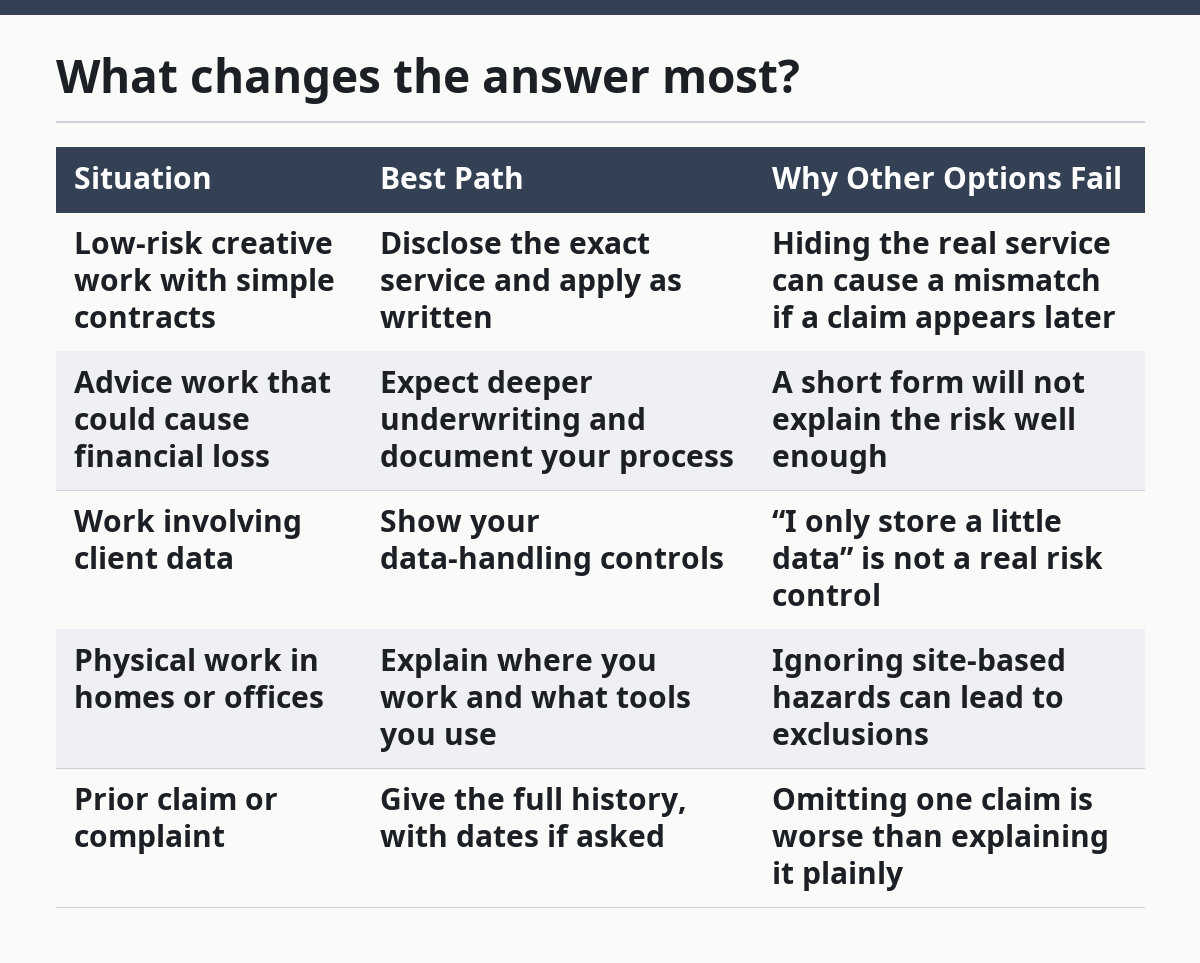
Three things change the answer most: the service you provide, the claim history behind you, and the contract risk you accept. If one of those three is high-risk, the rest of the application matters less. If all three are low-risk, eligibility is often much easier.
Here is the comparison that matters most:
| Situation | Best Path | Why Other Options Fail |
|---|---|---|
| Low-risk creative work with simple contracts | Disclose the exact service and apply as written | Hiding the real service can cause a mismatch if a claim appears later |
| Advice work that could cause financial loss | Expect deeper underwriting and document your process | A short form will not explain the risk well enough |
| Work involving client data | Show your data-handling controls | “I only store a little data” is not a real risk control |
| Physical work in homes or offices | Explain where you work and what tools you use | Ignoring site-based hazards can lead to exclusions |
| Prior claim or complaint | Give the full history, with dates if asked | Omitting one claim is worse than explaining it plainly |
If your contracts add duties you did not create yourself, eligibility can change fast. A clause that shifts broad liability to you may turn a basic freelance job into a higher-risk underwriting file. That can affect professional indemnity, general liability, or both, depending on the policy wording. The underwriter is not only judging the work itself; it is judging the promise you made in the contract.
Location matters too, but not in a one-size-fits-all way. Rates, limits, and legal rules differ by country and sometimes by state or province. A freelancer who works across borders can trigger extra questions about jurisdiction, tax registration, and where a claim could be filed. That is one reason the same job can be easy to insure in one market and harder in another.
A clean record still does not guarantee easy approval. The insurer may not love a freelancer who works for only one client, because that can create concentration risk. It may also dislike work that depends on deadlines with large financial consequences if a mistake delays a launch, filing, or campaign. Underwriting is less about “good person” and more about “predictable exposure.”
If you need a public source on how insurers and regulators think about policy wording and disclosure, the Financial Conduct Authority in the UK and the National Association of Insurance Commissioners in the US are both reliable starting points. For freelancers in the UK, HMRC’s guidance on self-employed work is also useful for defining the business side of your setup, though it is not an insurance rulebook.
Quick check: If your biggest risk is the service itself, the claim history, or a contract clause, that is the part the underwriter will zoom in on first.
How does the application work?
The application works by turning your freelance work into a risk file, then matching that file to the insurer’s rules. If you answer clearly and the work is inside the insurer’s comfort zone, the process can move quickly. If your answers are vague, inconsistent, or incomplete, expect follow-up questions and possible delays.
A typical application is not complicated, but it is unforgiving. The underwriter may ask for your business name, service description, annual turnover or projected income, trading history, prior claims, subcontractor use, and the countries where you work. For some policies, a professional qualification or membership number may also matter. For others, your contract template matters more than your diploma.
Here is a practical 6-step path that fits most freelancer applications:
- Write one exact description of what you sell, using plain language and no marketing fluff.
- List the types of work you refuse, such as regulated advice, payment handling, or on-site hazardous tasks.
- Collect your basic business facts: trading start date, clients, locations, and any subcontractors.
- Prepare a short claim and complaint history, even if the answer is “none.”
- Review any client contract that changes your liability, indemnity, or dispute terms.
- Check the policy wording for exclusions tied to your actual work, not just the summary page.
The last step matters more than many freelancers expect. A summary sheet can make a policy look broad, while the wording may carve out exactly the thing you do most often. If you are a freelancer, that gap can hurt you later. The policy wording is the real contract, not the sales page.
A strong application does not mean oversharing. It means giving the underwriter enough detail to classify the risk correctly. Too little detail leads to assumptions, and assumptions are bad for both pricing and claims handling. Too much irrelevant detail can also slow things down, because the file becomes harder to sort.
If your work changes often, ask yourself one simple question before you apply: “What would I say if the underwriter asked me to explain my busiest month in three sentences?” That answer usually shows whether your current application is too narrow or too broad. A freelancer who does five different jobs in a week needs a cleaner service description than someone with one fixed product.
Quick check: If your application would sound different from your website, your contract, or your invoices, fix the mismatch before you submit anything.
When standard advice is wrong?
Standard advice is wrong when your work is unusual, your contracts are aggressive, or your business sits across more than one country. In those cases, the usual “just fill out the form” guidance misses the real risk trigger. The right answer changes as soon as the normal assumptions stop fitting.
Edge cases where the normal advice breaks down
-
You work through a platform but sign your own client terms. What changes: the platform is not the real risk holder; you are. What to do instead: describe the actual client relationship, not the marketplace label.
-
You subcontract parts of the job. What changes: the underwriter may care about supervision, vetting, and who is liable for mistakes. What to do instead: list the subcontracted tasks and the controls you use, such as written scopes and review steps.
-
You work in more than one country. What changes: law, jurisdiction, and policy response can differ by place. What to do instead: tell the insurer every country where work is done or where clients are based, because cross-border work can change eligibility.
-
Your contract includes a strong indemnity clause. What changes: you may have taken on more liability than the standard policy expects. What to do instead: flag the clause before binding cover, since the wording may be excluded or not fully covered.
-
You do a mix of low-risk and high-risk services. What changes: the insurer may only agree to some parts of your work. What to do instead: break the business into service lines, then ask which ones are included and which ones are not.
-
You had a prior claim, even a small one. What changes: the underwriter may care more about pattern than size. What to do instead: be ready with dates, facts, and what changed afterward, because a clean explanation is better than a short one.
The mistake in many generic guides is pretending every freelancer can answer the same way. A web designer with one client contract and no data access is not in the same box as a freelance bookkeeper who handles sensitive records. A freelancer serving public events is not the same as a proofreader working at home. The policy type may sound similar, but the risk mechanics are not.
This is also where not all “cheap” options are equal. A lower premium can come with tighter exclusions, a smaller limit, or more conditions on claims handling. That does not mean the higher quote is automatically better either. It means the difference has to be read in the wording, not guessed from the price.
Quick check: If your work crosses borders, uses subcontractors, or includes an indemnity clause, standard one-size-fits-all advice is not enough.
What should I prepare before I apply?
You should prepare a clear work description, a short history of your business, and the main documents that explain your risk. If you bring those three things together first, the underwriting process is usually much easier to read and less likely to stall. A 15-minute prep step can save days of back-and-forth later.
The most useful documents are often the plainest ones. A service list, sample contract, website bio, invoice template, and any written client terms can tell the underwriter far more than a long explanation. If you have prior insurance, the expiry date, policy type, and any claims history may also matter. For some freelancers, a trade association membership or professional qualification can help explain the line of work, though it does not guarantee eligibility.
Use this checklist before you submit anything:
- Describe your work in one sentence that a client would still understand.
- Separate your core services from optional extras.
- List the countries where you work, sell, or sign contracts.
- Collect your claim history, even if there are no claims to report.
- Review the client contract for indemnity, warranty, and dispute language.
- Keep a copy of everything you submit, including email answers and attachments.
That last step matters because underwriting is not just about the first decision. If there is a claim later, the file is often checked against the original answers. A mismatch between your application and your actual work can become a serious problem if the insurer says the risk was misdescribed. This is why accurate wording is worth more than a polished pitch.
A few things do not help much. A fancy portfolio does not replace an honest risk description. A vague title like “creative consultant” does not help the underwriter classify the work. And a promise that you “never make mistakes” is useless, because insurers price real-world error, not perfection.
If you want one practical benchmark, think in terms of a 12-month policy cycle. What you write today should still be true for the next year, or at least still true enough that you can report changes if your work shifts. That is usually the safest way to keep underwriting aligned with reality.
Quick check: If your business changed in the last 6 months, your application should reflect the current version, not the old one.
What are the signs you may be declined or restricted?
You may be declined or restricted if your work is too broad, your contracts are too aggressive, or your past claims suggest a pattern the insurer does not want. If the underwriter cannot fit your work into a standard policy form, it may offer exclusions instead of full cover, or refuse the risk altogether. That is not personal; it is how the file is classified.
The warning signs are usually visible before the final answer. Very high-risk advice work, client money handling, regulated services, repeated claims, or unclear service descriptions can all raise the chances of a problem. If you cannot explain your work in one clear paragraph, the insurer may struggle to price it. If you can explain it but the contract adds a lot of liability, the insurer may still narrow the cover.
A restriction can be less dramatic than a refusal, but it still matters. One common result is a policy that covers only certain services, not the full freelance business. Another is an exclusion for work done outside a named country or for a specific type of claim. A third is a higher deductible or a request for more risk controls before the policy starts.
If you receive a decline, the next question is not “Why did this happen to me?” The better question is “Which part of the risk did the insurer not want?” That answer tells you whether the problem is the service, the contract, the geography, or the claims history. The fix depends on that diagnosis.
A decline can be a signal, but it does not always mean the search is over. If one insurer says no because your work is outside its box, another specialist insurer may be able to look at the file differently. The important part is not to paper over the reason for the first refusal. You need the real issue in plain language.
Quick check: If your service is hard to describe, your contract shifts liability, or your claims history is messy, a restriction is more likely than a clean approval.
What questions should I ask before I bind cover?
You should ask how the insurer defines your service, what it excludes, and what happens if your work changes after the policy starts. Those three questions catch most of the expensive surprises. If the answers are unclear, the policy is not ready for a freelancer who depends on accurate cover.
Ask these direct questions before you accept terms:
- Is my exact service included as described?
- Are subcontractors covered, and under what conditions?
- Does the policy respond to work done in every country I listed?
- What claims or incidents must I report right away?
- Are there exclusions tied to the contract I use?
- What changes would require a new application or endorsement?
If the insurer or broker answers in vague language, ask for the wording in the policy schedule or the full terms. A summary email is useful, but the policy wording controls the claim. That distinction matters in every country and under every policy form. It is one of the few things in insurance that stays true across markets.
The most useful habit is to treat underwriting as a description problem, not a persuasion contest. If you are unsure whether your wording is accurate, consult a qualified insurance professional and use a source such as the Financial Conduct Authority or the National Association of Insurance Commissioners for general guidance. The insurer is not looking for a sales pitch. It is looking for a truthful map of the work so it can decide whether to offer terms. If you understand that, you can answer better and waste less time.
One final point: eligibility is not permanent. A freelancer who starts with a low-risk service and later adds data processing, consulting, or subcontracted work may need a different assessment next year. If the business changes, the risk changes with it. That is normal, and it is why one application should not be copied forever.
Quick check: If you cannot point to the exact wording that covers your main service, you should ask more questions before binding anything.
FAQ
Does having no claims mean I will get approved?
No, it helps but it does not decide the outcome by itself. Underwriting still looks at the kind of work you do, the contracts you sign, and where the work is done. A clean record is useful, but a risky service can still lead to restrictions or a decline.
Can a freelancer with only one client still be eligible?
Yes, but the underwriter may look more closely at concentration risk and contract terms. If one client controls most of your income, the insurer may want to know how dependent you are on that relationship. A 12-month policy term can still be possible, but the file may need more detail.
Why does my website description matter?
Your website is often the fastest way an underwriter checks what you actually sell. If the website says one thing and the application says another, that mismatch can slow the file or create later problems. Make the service description match the real work, not the marketing version.
What if I work online and never visit clients?
That usually lowers some physical risks, but it does not remove professional risk. Online freelancers can still face claims about missed deadlines, wrong advice, data issues, or contract disputes. The absence of site visits helps in some cases, but it is not a full shield.
Do I need to worry about country differences?
Yes, because rates, legal rules, and policy wording differ by country and can change over time. A freelancer who works across borders may need to disclose every relevant location. If your work spans more than one country, ask a qualified adviser to review the policy language for your own situation.
Drafted with AI; not yet reviewed by a person.
