
Last updated: November 22, 2026
Quick Answer: most freelancers should start with 2 coverages: professional liability and general liability. If you store client data, add cyber coverage to the review. For readers comparing Freelance policy selection and coverages — The Complete Guide, the first question is what your work can actually break, damage, or expose. The exact coverages depend on what you do, what client data you handle, whether you give advice or creative work, and what a contract requires. A web designer, consultant, photographer, and virtual assistant do not need the same policy stack.
Key takeaways
- Start with the risk that can cost you the most: a mistake in your work, a third-party injury, or a claim tied to data.
- General liability and professional liability solve different problems, and many freelancers need both.
- Client contracts can force you to carry specific limits, certificates, or extra insured wording.
- Cheap-looking coverage can fail if the policy excludes the exact service you sell.
- The best policy is often the one that matches your actual work, not the one with the broadest name.
What coverage does a freelancer actually need?

A freelancer usually needs coverage for three different risk buckets: injury claims, work mistakes, and business interruption or property loss. The core question is often “What can go wrong in the way I earn money?”
Therefore, general liability is about third-party bodily injury, property damage, and some advertising injury claims. Professional liability, often called errors and omissions or E&O, is about financial harm caused by a service, advice, design, or professional mistake. The U.S. Small Business Administration has a plain-language overview of business insurance needs on its site, and the Insurance Information Institute explains general liability as a policy for claims involving injuries or damage caused to others. See the SBA’s business insurance guidance and the Insurance Information Institute’s liability pages for a baseline.
That split matters because a lot of freelancers buy one policy and assume it covers all of it. It usually does not. A photographer who knocks over a client’s lamp needs a different answer than a bookkeeper who misses a tax filing deadline. A brand strategist who gives advice about positioning also has a different risk than a courier or a painter.
For example, the easiest way to choose is to list your real exposures in this order: people, property, advice, data, and contract terms. If your work is mainly advice or deliverables, professional liability is usually the first policy to inspect. If you meet clients in person, bring gear onsite, or rent space, general liability moves up the list. If your work touches payment data, personal records, or login credentials, cyber-related coverage deserves a hard look.
General liability or professional liability?
General liability wins when your work creates a third-party injury or property claim; professional liability wins when your work creates a financial-loss claim from a mistake in your service. They are not substitutes for each other, and that is where many freelancers get burned.
Here is the cleanest way to think about the difference: general liability is about the world around your work, while professional liability is about the work itself. If a client slips on a wet floor during an onsite shoot, that is general liability territory. If you file the wrong version of a document and the client loses money, that is professional liability territory.
The mistake generic articles make is treating “liability insurance” as one thing. It is not, and if you are unsure how to classify your work, consult a licensed insurance professional or broker and use the SBA and Insurance Information Institute as starting points. A freelance copywriter who only buys general liability may still be exposed if a client sues over a missed deadline, a factual mistake, or a claimed loss tied to the work. A consultant who only buys professional liability may still be exposed if a client trips over a cable in the meeting room.
This table shows the practical choice point.
| Criteria | General liability | Professional liability | Winner for [condition] |
|---|---|---|---|
| Main risk covered | Third-party injury or property damage | Financial harm from advice, service, or mistake | Depends on the risk source |
| Best for | Onsite work, client visits, rented space | Consulting, design, writing, bookkeeping, coaching | Based on the service you sell |
| Typical claim trigger | Someone gets hurt or property is damaged | Client says your work caused a loss | Professional liability for service errors |
| What it usually does not cover | Work-quality disputes and bad advice | Slips, falls, and property damage | Neither alone covers everything |
| Contract demand | Common in venue and landlord contracts | Common in client service agreements | Depends on the client |
| Fit for remote-only freelancers | Often lower priority | Often higher priority | Professional liability |
| Fit for equipment-heavy work | Helpful if gear is used onsite | Less helpful for physical incidents | General liability |
| Fit for advisory work | Usually not enough | Usually the core policy | Professional liability |
| Common blind spot | Assuming “liability” includes service mistakes | Assuming it covers bodily injury | The policy that matches the risk |
| Cost logic | Often tied to physical exposure | Often tied to professional exposure | Depends on claims type |
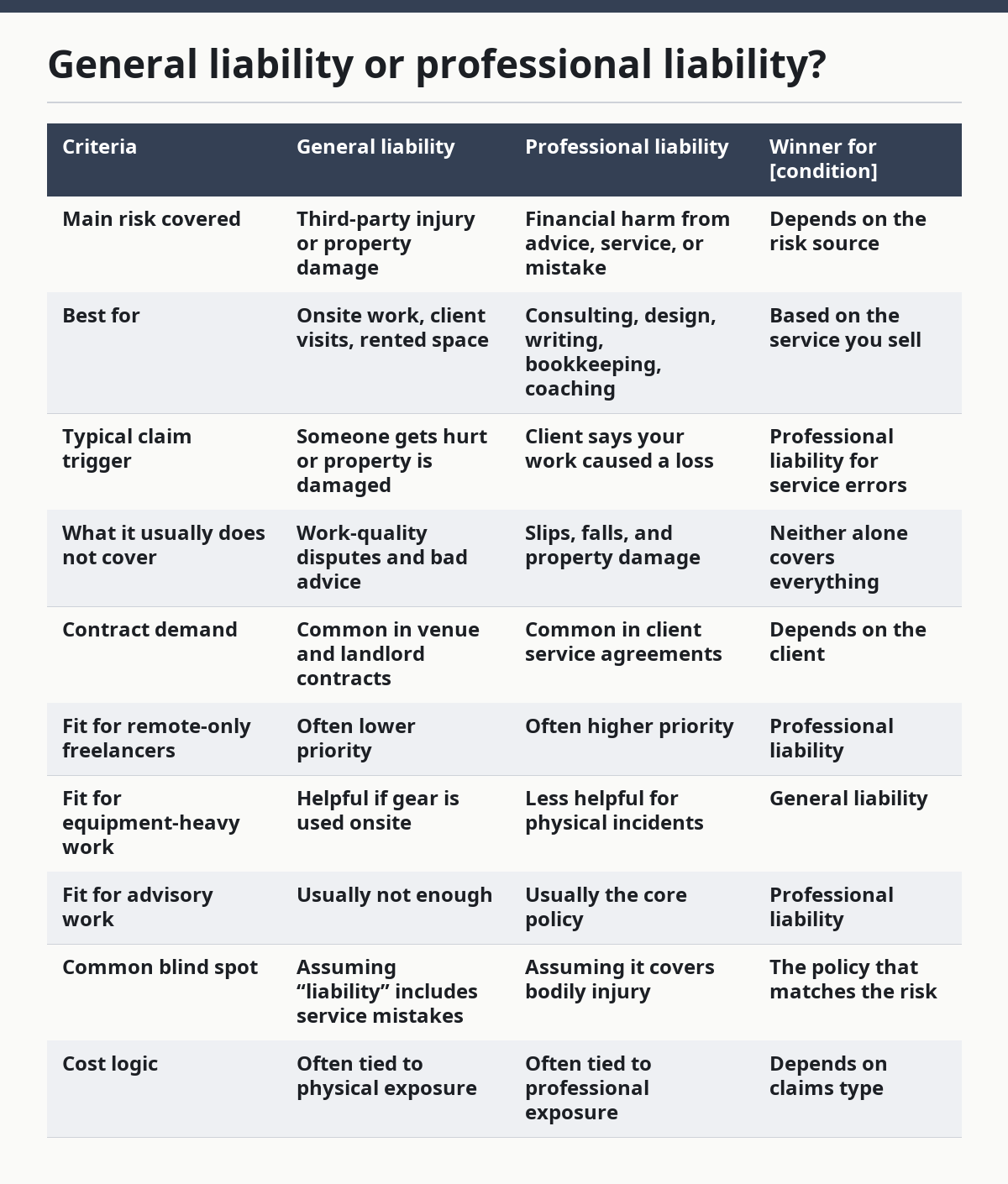
The right call for many freelancers is not either-or. If you work with clients in person and also deliver advice or creative work, you may need both. If budget is tight, start with the policy that matches the claim most likely to hurt you badly. For a solo consultant, writer, designer, or accountant, that is often professional liability.
Which coverages do most freelancers miss?

Therefore, most freelancers miss cyber coverage, hired and non-owned auto exposure, and business property coverage because those risks hide in plain sight. Those gaps can matter even when the main liability policy looks fine.
Cyber coverage matters when you store customer files, send invoices, use cloud tools, or handle login access. A stolen laptop is not the real problem by itself; the real problem is the fallout from exposed data, downtime, and client notification costs. If you keep client records on a phone or laptop, treat cyber risk as a live issue, not a future one. For a closer look, see the FTC’s guidance on data security and the SBA’s small-business cybersecurity resources.
Hired and non-owned auto coverage matters if you rent cars for client work or drive your own car for business errands. Many freelancers assume their personal auto policy will automatically behave like a business policy. That assumption can fail when the trip is clearly work related, so the policy language deserves a close read.
Business property coverage matters if your gear, inventory, samples, or office equipment would cost real money to replace. A laptop, camera, microphone, printer, or lighting kit can be essential to the job. If one loss would stall your income for days, the business property question is not minor.
A lot of coverage gaps come from one bad habit: buying based on job title instead of task list. “I am a freelancer” is not enough information for an insurer. The underwriter wants to know whether you advise clients, handle payroll, visit sites, store data, use subcontractors, or work under a signed service agreement. Your policy should follow those facts.
What does your contract change?
A client contract can change your insurance choice more than your job title does. If the agreement names required limits, asks for a certificate of insurance, or wants additional insured status, your policy has to fit the paperwork, not just the work.
This is where freelancers get surprised. A contract may require general liability even if you work from home. It may also require professional liability if the client is buying advice, technology services, or creative work with a measurable business outcome. Some contracts also require specific language about subcontractors, indemnity, or waiver of subrogation.
That is why a cheap policy can become expensive fast. A policy that technically exists but fails the contract check can force you to buy an urgent endorsement, replace the policy, or lose the job. The contract is not decoration. It is part of the risk profile.
For readers looking at policy selection, the most useful habit is to compare the contract requirements against the declarations page and exclusions before signing anything. Ask three questions: Does the policy cover the kind of work in the contract? Does it meet any required limit or certificate language? Does it exclude claims tied to the exact service being sold?
If the answer to any of those is “maybe,” pause and get clarification from the insurer or a licensed broker. This is one of the few places where a quick professional check can prevent a very expensive mismatch.
How do you choose limits and deductibles?
Choose limits and deductibles by looking at the size of the claim you could realistically face, the cash you can spare, and the contract minimums you must meet. A higher deductible lowers the premium burden, but it also means more out-of-pocket pain when a claim lands.
A freelancer should not pick a deductible just because it sounds manageable on a good month. The real test is whether that amount is still possible after a delayed invoice, a slow quarter, or a client dispute. If a deductible would force you to use credit at the exact moment you need to respond to a claim, it is too high.
Limits work the same way. A policy that looks adequate for a small task can fail if your contract or client base changes. A freelancer with one local client has a different exposure than someone handling national brands, payments, or data-heavy projects. The stronger the client, the more they may expect broader coverage and cleaner documentation.
The cleanest approach is to set coverage from the outside in. Start with the contract’s minimum requirement if there is one. Then consider the largest loss you could reasonably create through your work. Then check whether your savings can absorb the deductible without putting your business at risk for 30 days or more. That method is less glamorous than guessing a round number, but it is far safer.
Which freelancers need more than one policy?
Freelancers who work onsite, handle data, and sell advice usually need more than one policy. The more your job mixes physical, digital, and advisory risk, the less likely a single policy will protect you well.
A freelance photographer who shoots on location may need general liability for site-related injury or damage and property coverage for gear. A freelance developer may need professional liability for software errors and cyber coverage for data handling. A consultant may need professional liability first, then general liability if they meet clients in person or rent work space.
The same logic applies to writers, marketers, bookkeepers, and virtual assistants. A writer who only turns in copy may live mostly in professional liability territory. A virtual assistant who manages sensitive records may need cyber review as well. A bookkeeper who touches financial records has a stronger reason to inspect professional liability carefully than a freelancer who only creates social posts.
The wrong move is to buy insurance by broad category and stop there. “Freelancer insurance” is not a standard policy label with one fixed meaning. It is a shorthand for a package assembled around your actual exposures. The more varied your services, the less likely a single policy will be enough.
The honest side-by-side
The policy stack depends on what you sell, but the comparison below shows the decision points that matter most.
| Criteria | General liability | Professional liability | Winner for [condition] |
|---|---|---|---|
| Protects against bodily injury claims | Yes | Usually no | General liability |
| Protects against service mistakes | Usually no | Yes | Professional liability |
| Useful for in-person client meetings | Yes | Sometimes | General liability |
| Useful for advice, design, or consulting | Limited | Yes | Professional liability |
| Often requested by landlords or venues | Yes | Less often | General liability |
| Often requested in service contracts | Sometimes | Yes | Professional liability |
| Covers third-party property damage | Yes | Usually no | General liability |
| Covers financial loss from bad work | Usually no | Yes | Professional liability |
| Good first policy for remote-only advice work | Not usually | Yes | Professional liability |
| Good first policy for onsite, gear-heavy work | Yes | Sometimes | General liability |
The table points to one clear truth: the policy should match the source of the claim. If the harm comes from a person or property, general liability is the first stop. If the harm comes from the quality or timing of your work, professional liability is the first stop. That is the cleanest selection rule for freelancers.
When should you add cyber coverage?
Add cyber coverage when you store client data, use cloud tools, accept online payments, or keep login access for client accounts. If a data event would force you to notify clients, recover records, or pause work, the risk is large enough to review.
This coverage is often left out because it feels like a tech-company problem. It is not. A solo designer, copywriter, assistant, bookkeeper, recruiter, or coach can still hold private data, payment details, or business credentials. A lost password or exposed inbox can create a claim even if the freelancer never wrote code.
The drawback is that cyber coverage can sound broader than it really is. Some policies focus on data breach response and leave other tech-related disputes to separate forms or endorsements. That means the buyer has to read the insuring language closely instead of trusting the label. If your work depends on the internet, the label alone is not enough.
Cyber coverage is especially worth a second look if you would need outside help after an incident. If one problem would require legal notice, forensic review, account recovery, or client communication, the policy may pay for more than just the direct repair. That is the point where the coverage starts to look less optional.
What are the exception scenarios?
However, the overall choice flips in a few specific cases, and those cases are common enough to matter.
A freelancer who never gives advice and never meets clients in person may not need both core liability policies right away. If the work is entirely digital and the main exposure is process error, professional liability still matters more than general liability.
A freelancer who rents a studio, sees clients on site, or handles equipment in shared space should give general liability more weight, even if the work is mainly creative or advisory. Physical risk can be small until one person falls, one camera stand tips, or one venue contract demands proof.
A freelancer with heavy data exposure may need cyber review before anything else. If the client files are sensitive, the login access is broad, or the records are hard to replace, the data risk can outrank the rest.
A freelancer who works under a strict client contract may need to follow the contract first and the job title second. The agreement can force a policy type, endorsement, or limit that changes the whole buying decision.
What should a freelancer buy first?
Buy professional liability first if your work is advice, design, writing, consulting, bookkeeping, coaching, or any service where a client can claim your work caused a loss. Buy general liability first if you meet clients in person, work in rented space, or bring equipment into places where someone else could get hurt or damaged property could be involved.
That is the shortest honest rule. It is not perfect, but it is practical. If the work can fail on paper, on screen, or in a spreadsheet, professional liability is the core question. If the work can fail in a room, at a venue, or around physical gear, general liability moves up.
Neither policy should be chosen in a vacuum. A freelancer with online records, client contracts, and equipment may need all three layers: professional liability, general liability, and cyber coverage. That is not overkill for many solo businesses; it is the cost of carrying real exposure in a one-person operation.
The biggest mistake is buying the policy that sounds broadest. The second biggest mistake is buying a policy and never checking whether your actual service falls inside the covered class of business. Both mistakes are easy to make and expensive to fix.
The verdict: which policy stack should you choose?
Choose professional liability first if you sell advice, creative work, technical services, bookkeeping, or anything where a client could claim your work caused financial loss. Choose general liability first if you meet clients in person, rent space, or bring gear onsite. Neither if your policy excludes the exact service you sell or you have not checked your client contract.
That is the cleanest decision rule for freelancers. If your work is mostly remote and intellectual, professional liability is usually the better first dollar spent. If your work is physical, public-facing, or venue-based, general liability comes first. If you do both, you likely need both.
What should you check before you buy?
Check the policy wording, the exclusions, the contract requirements, and the type of claim the policy is built to handle. Those four things decide whether coverage will help when something goes wrong.
Start with the declarations page, then read the exclusions, then compare the policy to your real work list. If the wording says one thing and your contract says another, resolve that before signing. If the insurer will not confirm the fit in plain language, treat that as a warning sign.
A policy is only useful if it responds to the business you actually run. Freelancers do not need insurance that sounds impressive; they need insurance that survives a real claim, a real contract, and a real deadline. That is the standard that matters.
Is one policy enough for a freelancer?
No, one policy is not enough for many freelancers because different risks cause different kinds of claims. A policy that covers mistakes in your work may still leave you open to injury or property claims, and the reverse is also true.
The simplest check is to ask what would happen if a client sued for a bad result, a visitor got hurt, or a laptop with client files went missing. If the same policy does not clearly answer all three questions, you are looking at a gap. That gap is the reason many solo businesses end up with a policy bundle rather than one policy.
How often should freelancers review coverage?
Review coverage when your services change, your contracts change, or your client base changes. A yearly review is a reasonable habit, but a major project or a new client requirement can make that review necessary sooner.
The reason is simple: the risk profile of a freelancer is not fixed. New tools, new data access, new locations, and new subcontractors can all change what the policy needs to cover. A policy that fit last year may be wrong after a single contract change.
Where should a freelancer get help?
A licensed broker or insurance professional is worth contacting when the contract language is unclear, the service mix is complicated, or the policy wording is hard to compare. This is especially true when you are unsure whether your work counts as advice, technical service, or physical work.
Government and industry references can also help you sanity-check the basics. The SBA business insurance guidance and the Insurance Information Institute’s liability explanations are useful starting points, though they do not replace a policy review. For coverage questions that affect a contract or a claim, a professional consultation is the safer path.
Drafted with AI; not yet reviewed by a person.
