
Last updated: November 23, 2026
Quick answer: there are 8 core checks in How to Prepare a Freelance Insurance Renewal Questionnaire, and the cleanest renewal file usually starts with the last term’s questionnaire, the current declarations page, and a list of changes from the last 12 months. Gather the prior questionnaire, note what changed since the last term, and attach any carrier-requested applications, endorsements, or support documents that explain those changes. If anything is unclear, consult a qualified insurance professional for your own situation and check the carrier’s instructions. See the NAIC’s consumer guidance on policy changes and endorsements: https://content.naic.org/consumer_insurance
Key takeaways
- Treat the renewal questionnaire like a record check, not a sales form.
- Start with the last policy term and mark only what changed.
- Keep answers tied to carrier questions, not to guesswork.
- Attach proof for material changes such as new services, higher revenue bands, or added staff.
- Stop and get help if the questionnaire asks for a coverage change you do not understand.
Who should prepare it?

This preparation process fits a freelancer who already has a current policy, has the prior-year paperwork, and can list business changes from the last 12 months. It also fits anyone who is renewing with the same carrier and needs to answer the questionnaire without turning it into a full rewrite.
It does not fit every case. If the carrier is asking for a new application, a rewritten class code, or a change in the policy structure, the questionnaire is no longer a simple renewal task. That is a sign to slow down and get qualified help before you sign anything.
A useful starting set is simple: the last renewal questionnaire, the current declarations page, any endorsement notices, and a note of what changed in the policy term. The term matters because renewals usually ask about the period since the last effective date, not the whole life of the business. For a broader checklist, see what you should gather first.
What should you gather first?
You should gather the prior renewal file, the current policy documents, and a short list of business changes before you touch the form. That gives the carrier a clean picture of continuity, which is the point of a renewal questionnaire.
Prepare these items in one place:
- the last completed renewal questionnaire
- the current declarations page
- any endorsement letters from the carrier
- the policy term dates
- updated applications or supplemental forms the carrier asked for
- notes on operations, clients, locations, and subcontractors
- support for any change you plan to report
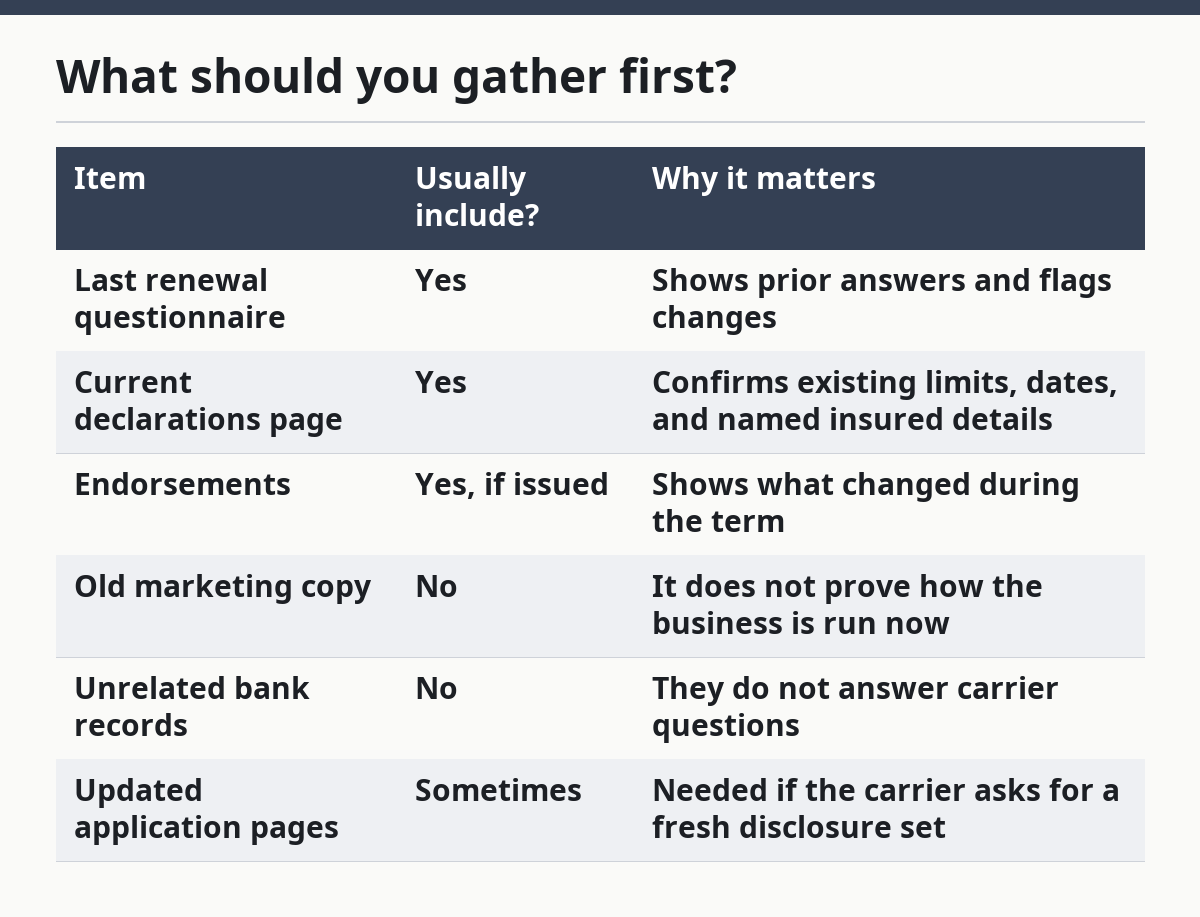
A comparison table helps sort what belongs in the packet and what does not.
| Item | Usually include? | Why it matters |
|---|---|---|
| Last renewal questionnaire | Yes | Shows prior answers and flags changes |
| Current declarations page | Yes | Confirms existing limits, dates, and named insured details |
| Endorsements | Yes, if issued | Shows what changed during the term |
| Old marketing copy | No | It does not prove how the business is run now |
| Unrelated bank records | No | They do not answer carrier questions |
| Updated application pages | Sometimes | Needed if the carrier asks for a fresh disclosure set |
If a document does not answer a question the carrier asked, it usually does not belong in the renewal packet. Too much paper can slow review just as much as too little.
How do you answer the questionnaire step by step?

You answer it by matching each question to a current fact, then showing what changed since the last policy term. That method keeps the form aligned with the carrier’s underwriting questions and cuts down on back-and-forth.
- Read the full questionnaire once before filling anything in. Mark every question that asks about revenue, staff, subcontractors, client types, services, or locations. Verify the carrier’s deadline and the policy term dates. A problem shows up if you see a question you cannot answer from records alone.
- Compare the questionnaire with last year’s version. Put the old answers beside the new form and note any wording that changed. Verify whether the carrier added a new application section or endorsement question. A problem appears when a question is new but you answer from memory.
- List business changes for the last 12 months. Note changes in services, tools, delivery methods, subcontracting, business names, offices, or client mix. Verify each change against invoices, contracts, or an internal record. A problem appears if you cannot tie a change to a source document.
- Confirm coverage details before you answer coverage questions. Check the declarations page for the current carrier name, policy number, effective date, and listed coverage parts. Verify that you are answering about the active policy, not an expired one. A problem appears if the questionnaire references a policy part that no longer matches the declarations page.
- Answer with the current year’s facts, not the prior year’s assumptions. Use the present headcount, present services, and present operations as they stand at renewal. Verify that each answer fits the policy term the carrier is asking about. A problem appears if an answer says “same as last year” but the operation changed midway through the term.
- Attach support only where the carrier asks for it. Add applications, endorsements, or explanatory notes when a question points to a change or a discrepancy. Verify that each attachment is labeled and dated. A problem appears if the form says one thing and the attachment says another.
- Flag any answer that depends on a judgment call. If a question asks whether a service counts as a new exposure, mark it for review instead of guessing. Verify whether the carrier has defined the term in the questionnaire or the application. A problem appears when a vague answer could be read as a misstatement later.
- Do a final line-by-line check before sending it. Confirm names, dates, policy number, and any yes/no responses that carry a follow-up question. Verify that no blank boxes remain where the carrier expects a reply. A problem appears if the questionnaire cannot be matched cleanly to the policy term or to the supporting papers.
That process is slower than filling boxes from memory, but it is the safer way to avoid contradictions between the questionnaire and the carrier’s file.
What counts as a change the carrier wants to know?
A carrier usually wants to know about anything that changes the risk profile or the way the business operates. For a freelancer, that often means updated operations, new service lines, changes in subcontracting, higher gross receipts bands, or a new business location.
Do not wait for a dramatic event. A small shift, like adding a new software platform, taking on a different client type, or hiring help for a recurring project, can matter if it changes how the work is done. The renewal questionnaire is designed to catch those changes before the next policy term begins.
A plain rule helps: if the change could affect how the carrier writes the policy, it belongs on the questionnaire or in the follow-up papers. If the change only affects your filing cabinet, it probably does not.
When should you stop and ask for help?
You should stop when the questionnaire stops being a simple continuity check and starts asking for a coverage decision. At that point, the form is no longer just administrative, and a qualified insurance professional should review it with you before you sign.
The questionnaire asks for a new application. That usually means the carrier is treating the renewal as more than a routine update — ask for qualified help before you submit anything.
Your current operations no longer match the declarations page. That usually means the existing record may be stale — stop and confirm how the carrier wants the mismatch handled.
The carrier asks whether a new service is covered. That usually means the form is drifting into coverage analysis — do not guess, because a wrong answer can misstate the risk.
The questionnaire conflicts with an endorsement you received earlier in the term. That usually means the file may not be internally consistent — gather the endorsement and get the carrier to reconcile it. See the NAIC’s guidance on endorsements: https://content.naic.org/consumer_insurance
You cannot explain a change in revenue, staffing, or subcontracting with a document. That usually means the answer is weakly supported — pause until the backup is clear.
You are being asked to sign a statement you do not understand. That usually means you do not yet know what you are attesting to — do not sign until the language is clear.
Each of those situations can affect how the carrier records the policy for the next term. A rushed answer can create a paper problem even when the business itself has not changed in a dramatic way.
What mistakes cause the most trouble?
The biggest mistakes are usually small, but they create confusion that the carrier has to clean up later. The cost is often delay, extra questions, or a file that no longer matches the policy term.
-
Answering from memory instead of records. The consequence is inconsistent answers across the questionnaire, declarations page, and endorsements. The better alternative is to verify every material answer against a dated document.
-
Copying last year’s answers without checking for change. The consequence is that the carrier may miss an updated operation or client mix. The better alternative is to compare line by line and update only what is current.
-
Attaching too many unrelated documents. The consequence is that the carrier has to sort through noise before finding the useful page. The better alternative is to attach only documents that answer a specific question.
-
Ignoring wording changes in the questionnaire. The consequence is that a familiar question can hide a new disclosure request. The better alternative is to read the current form as a new form, even if most lines look familiar.
-
Leaving a vague answer where the carrier expects specifics. The consequence is follow-up, not closure. The better alternative is to write the facts the question asks for and mark anything uncertain for review.
-
Treating endorsements as optional background material. The consequence is a mismatch between what the policy says and what the questionnaire suggests. The better alternative is to keep endorsement notices in the renewal packet when they change the picture, as the NAIC recommends reviewing policy changes carefully: https://content.naic.org/consumer_insurance
A renewal questionnaire should create a clean paper trail. If it creates a puzzle, then the process has gone off track.
What if the normal approach does not fit?
The normal approach needs adjustment when the business changed more than the questionnaire assumes. That happens with a new service, a move, a new ownership structure, a jump in subcontracted work, or a policy term with several mid-year endorsements.
In those cases, write answers that reflect the current operation and note which part of the change happened during the term. Do not force a one-line answer when the carrier needs a timeline. If the carrier asks for an updated application, use the renewal questionnaire as a bridge to that update, not as a substitute for it.
A simple timeline is often enough: what the business was at the start of the term, what changed, and what it looks like now. That structure helps the carrier read the file without guessing where the change began. It also keeps the renewal packet aligned with the actual policy history.
If the form asks about an exposure you do not have, say so plainly. If it asks about an exposure you do have but the wording is unclear, stop and ask for clarification before the answer is filed. The SBA’s recordkeeping guidance can help you organize the documents that support those answers: https://www.sba.gov/business-guide/plan-your-business/keep-good-records
How do you know the packet is ready?
The packet is ready when the questionnaire, the declarations page, and any requested attachments tell the same story. That means the policy term is clear, the carrier name is correct, and every material change has a matching note or document.
Usually, a good result is boring in the best way: no crossed-out answers, no unexplained gaps, and no surprise follow-up about facts that should have been visible from the start. The page should read like a current snapshot of the freelance business, not like a guess about it.
That is also the point where the renewal planning hub can help with the next step in the broader process, since this page is only about preparing the questionnaire itself.
What changes should I report at renewal?
Report changes that affect how the freelance business operates or how the carrier reads the risk. That usually includes services, client types, staffing, subcontractors, locations, and major shifts during the policy term. If a change would make an answer different from last year, it belongs on the questionnaire or in the supporting papers.
How far in advance should I review a renewal questionnaire?
Review it as soon as it arrives, then give yourself time to compare it with the prior policy term papers. If there is a new application, a missing endorsement, or an unclear question, early review leaves room to ask follow-up questions before the deadline. A same-day review leaves little room for correction.
What documents should I gather before completing renewal questions?
Gather the last renewal questionnaire, the current declarations page, any endorsements, the policy term dates, and any carrier-requested applications. Then add support for changes such as updated operations, staffing, or subcontractors if the form points to them. The goal is to answer from current records, not from memory alone.
Drafted with AI; not yet reviewed by a person.
