

Last updated: November 24, 2026
Freelance insurance policy selection and placement means matching the cover to the work, the clients, and the contract, then buying it with the right limits, territory, retroactive dates, and endorsements. For a freelancer, the right policy is usually the one that fits the actual risk on the job, not the cheapest premium on the page. This is information, not financial advice; a qualified adviser should be consulted for your own situation.
Key takeaways
- The right policy starts with the work itself: advice, design, code, media, or physical services create different liability.
- Placement is not just “buy a policy.” It is the process of checking exclusions, limits, deductibles, and start dates before cover binds.
- A cheap policy can fail at the worst moment if the contract needs higher limits, a wider territory, or a past-work date.
- The biggest mistake is buying one broad-sounding policy and assuming it fits every client agreement.
- If a client contract names insurance terms you cannot meet, the gap needs a fix before work starts, not after a claim.
Who this guide applies to
This guide applies to freelancers, sole traders, and one-person businesses that need to understand liability cover before they sign a contract or invoice a client. It assumes the reader already knows the kind of work they do, but not how that work turns into insurance risk. It also assumes the reader is comparing policies, not shopping for a business name or logo.
The guide is most useful for people who do client work on a project basis: consultants, designers, developers, writers, marketers, photographers, coaches, and other independent workers. The core issue is the same across many fields: if a client says your mistake caused loss, the policy must respond to that kind of claim under its wording, not under its marketing headline.
This is not a substitute for tailored advice where the contract is unusual, the work crosses borders, or the exposure is large enough that a wrong clause could matter. A broker, adviser, or solicitor may be needed when a client demands specific wording, additional insured status, non-standard endorsements, or a higher limit than the market easily offers. If the policy wording is hard to read, that is already a sign to slow down.
What does freelance insurance policy selection and placement mean?
Freelance insurance policy selection and placement means choosing the policy form, then placing it with an insurer on terms that match the risk. “Selection” is the screening stage: what type of cover is needed, what limits apply, what exclusions matter, and which policy form fits the work. “Placement” is the binding stage: the application, proposal form, quotation, wording review, payment, and issue of documents.
For freelance work, the main question is rarely “Do I need insurance?” The harder question is “Which loss should this policy respond to, and when will it fail?” Professional indemnity, errors and omissions, public liability, employers’ liability where relevant, and cyber cover can all sit around the same business, but they do not answer the same claim. A public liability policy may help with injury or property damage; it usually does not replace professional indemnity for bad advice or a missed deadline.
The terms matter because insurers use them differently. A claims-made policy, for example, usually responds to claims first made during the policy period, subject to its wording. An occurrence policy usually turns on when the incident happened. That difference can decide whether old work is covered. The policy schedule may look neat on one page, but the exclusions and conditions control the real result.
A general source for policy language and coverage concepts is the Insurance Information Institute, which explains the difference between claims-made and occurrence forms on its own site: https://www.iii.org/article/claims-made-vs-occurrence-policies. For contract and consumer-facing insurance basics, the National Association of Insurance Commissioners also publishes plain-language material: https://content.naic.org/consumer.
Which risks matter for freelance work?
Freelance work creates at least four kinds of risk: advice risk, service error, injury or property damage, and data or cyber loss. The right policy depends on which of those is realistic in the work you sell. A writer who misses a publication deadline faces different exposure from a web developer who handles client data or a photographer working on-site with expensive equipment around the public.

Professional liability is the first bucket to examine. This is the cover that may respond if a client says the work was wrong, incomplete, negligent, or late. For a freelancer, that can include bad advice, incorrect documents, failed specifications, or a missed milestone that causes financial loss. If the work is advice-heavy, this policy often matters more than a general liability form.
Public liability, sometimes called general liability in some markets, matters when the work creates physical risk. A photographer at a venue, a contractor at a site, or any freelancer meeting clients in person may face claims for injury or accidental damage. If the business works only from a home office with no client visits, that exposure may be lower, but it does not vanish if equipment is taken off-site.
Cyber risk is a separate issue when data is handled, stored, or transferred. A freelancer may not be a tech company and still hold login details, customer records, payment information, or drafts containing confidential client material. A breach can trigger notification costs, recovery work, and a contract dispute. Standard liability wording may exclude or limit this, so the policy needs a careful read.
How do you choose the right policy?
Choose the policy by matching the contract, the work, and the claim scenario before looking at price. That sounds simple, but the order matters. If the premium comes first, the result is often a policy that looks affordable and fails the first time the wording is tested.
- List the exact services you sell. Write the services in plain language, such as copywriting, brand strategy, software development, photography, or consulting. Verify that the insurer’s business description includes those activities; if it does not, the problem is an activity exclusion or a wrong occupation code, which can leave the work outside cover.
- Read the client contract before quoting. Check the clause on insurance, indemnity, liability cap, governing law, and any requirement for certificates or additional insured status. Verify the required limit, territory, and wording; if the contract asks for terms that the policy cannot meet, the placement is incomplete before the work begins.
- Identify the claim type most likely to happen. Separate advice errors, injury claims, property damage, data loss, and defamation or intellectual property disputes. Verify which policy form answers each type; if one policy is being used to cover every risk, the gap is usually in the exclusions page, not the sales summary.
- Check whether the policy is claims-made or occurrence. A claims-made form usually needs the claim to be made during the policy period, and it may need a retroactive date. Verify the retroactive date on the schedule; if it starts too late, past work can fall outside cover even if the mistake happened years earlier.
- Compare the limits against the contract, not against a guess. Look at the per-claim limit, the aggregate limit, and any sub-limits for legal costs or cyber response. Verify that the policy limit is not eroded by defence costs unless that is clearly intended; if defence costs sit inside the limit, a long dispute can reduce the money left for settlement.
- Review exclusions line by line. Watch for exclusions on IP infringement, contractual liability, bodily injury, property damage, prior knowledge, overseas work, subcontractors, and deliberate acts. Verify whether an endorsement restores any of those areas; if the exclusion remains, the policy will not help in that scenario no matter how good the brochure sounds.
- Test the deductible or excess against cash flow. The deductible is the amount paid before the insurer contributes. Verify that the amount is affordable if a claim arrives during a quiet month; if not, a low premium can hide a deductible that is too painful to use.
- Confirm how the policy renews and ends. Check the renewal date, cancellation rules, notification duties, and any extended reporting period if the form is claims-made. Verify what happens to work done before cancellation; if there is no tail or extended reporting provision and the policy lapses, a later claim for old work may be uncovered.
This process is slow for a reason. The wrong answer is usually hidden in a single sentence in the wording, not in the quotation page. A freelancer who reads only the premium and the title of the cover is buying a label, not protection.
Which policy types are usually compared?
The main policy types are professional liability, public liability, cyber cover, and, in some cases, property or tools cover. Each one answers a different question, and one policy rarely replaces another. The comparison below is a short map, not a purchase recommendation.
| Policy type | Main risk it addresses | Typical trigger | Common limitation |
|---|---|---|---|
| Professional liability / professional indemnity | Bad advice, mistakes, missed deadlines, failed services | Claim tied to the work done | Often excludes bodily injury and many property claims |
| Public liability / general liability | Injury or damage caused to third parties | An accident or incident | Often does not cover advice errors or pure financial loss |
| Cyber cover | Data breach, privacy event, ransomware response costs | Security incident | May exclude poor password control or unapproved systems |
| Tools or equipment cover | Loss or damage to business equipment | Theft, fire, accident | May exclude unattended items or some off-premises use |
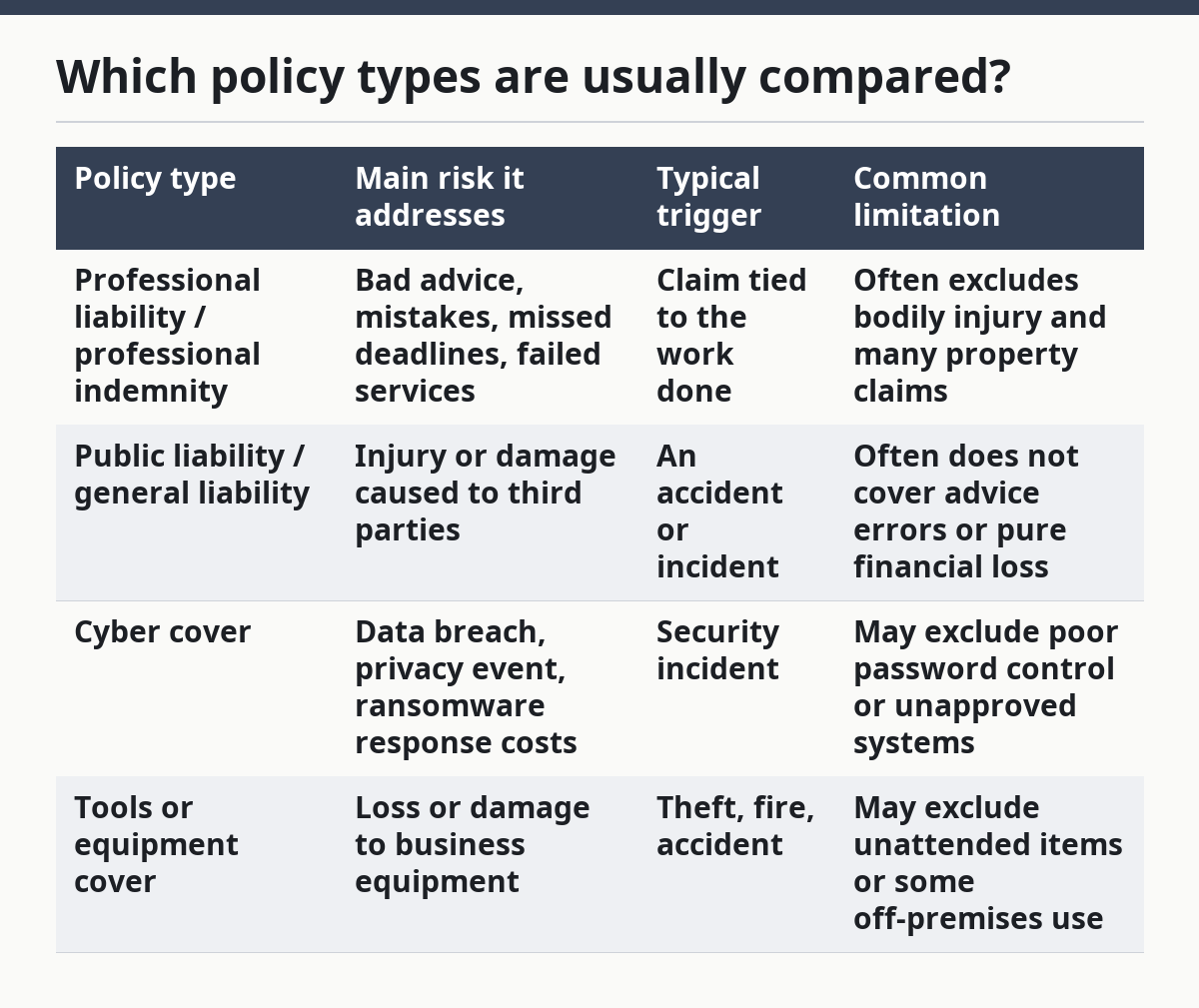
A common trap is assuming one policy can do all four jobs. Some bundled products do more than one, but the wording still matters. If the contract says the freelancer must hold professional indemnity and public liability, the policy has to meet both requirements separately. A certificate that names only one form of cover does not fill the gap.
The terms also shift by country and insurer. “Public liability” in one market can look like “general liability” in another, and policy wording changes from one carrier to the next. That is why the title on the front page is less important than the exclusions and endorsements inside.
What should be checked before placement?
The placement check is a document review, a wording review, and a contract review done before the premium is paid. The main job is to catch mismatch early, because fixing a bad placement after a claim is usually too late. The key documents are the proposal form, quotation, schedule, policy wording, endorsements, and the client contract.

The first thing to check is whether the business description is exact enough. A freelancer who says “marketing consultant” but also runs paid ad campaigns, handles client logins, and writes landing pages may need a policy that reflects all of that. If the insurer underwrites one activity and the freelancer does three, the gap can become an exclusion dispute.
The second check is territorial scope. Some policies cover only work in a named country; others include wider territory or worldwide work with exclusions. If the client, audience, or server location sits outside the home country, the policy needs to say so clearly. Cross-border work creates disputes fast because the contract, the claim, and the forum can all point in different directions.
The third check is who is insured. A sole freelancer may need the policy to cover subcontracted work, a business partner, or a trading name. If subcontractors are used, the wording may require them to carry their own insurance or meet specific controls. If that clause is ignored, a later claim can turn on who actually touched the work.
The fourth check is timing. A placement is weak if the cover starts after the work starts, or if the retroactive date does not reach old projects still live on a client’s shelf. For claims-made forms, timing is often the whole case. A gap of even 30 days can matter if a claim arrives in that window.
A useful source for complaint and policy guidance in the UK market is the Financial Ombudsman Service, which publishes insurance complaint material and plain-language examples: https://www.financial-ombudsman.org.uk/consumers/insurance. The local regulator in the reader’s country may have similar guidance, and the exact rules can differ.
When should placement stop?
Placement should stop when the contract, the wording, or the risk profile makes the policy a bad fit. That is not a failure; it is a sign that the risk needs a different solution, a specialist broker, or a contract change before work begins. On a money issue, a rushed policy can create the illusion of cover and leave the claim unresolved.
The policy is claims-made, but the retroactive date starts after older projects: earlier work may not be covered — stop and ask for a corrected date or a different form, because the policy may not respond to a claim from past work.
The client contract requires insurance wording the insurer will not add: the placement does not meet the contract — stop before signing, because the shortfall could become a breach of contract as well as an insurance problem.
The policy excludes the main service the freelancer sells: the cover is misaligned — stop and reclassify the business activity, because the exclusion may defeat the claim even if the premium is paid.
The work involves multiple countries and the policy territory is narrow: cross-border exposure is not priced correctly — stop and get the territory checked, because a claim in the wrong place can fall outside the policy.
The freelancer cannot absorb the deductible or excess if a claim happens: the cash flow test has failed — stop and lower the exposure or change the structure, because a deductible that cannot be paid turns a claim into a liquidity problem.
The work includes subcontractors, data handling, or intellectual property and the wording says little about them: the standard form is too thin — stop and review endorsements, because these are common loss areas for freelancers and are often the first place exclusions appear.
What mistakes do freelancers make?
The most common mistakes are reading the premium first, not the wording, and assuming the certificate is the policy. These errors are expensive because they create confidence without coverage. The policy may look fine until the first claim arrives, and by then the missing clause cannot be added retroactively.
One mistake is buying the lowest-priced policy and ignoring what it excludes. A freelancer may save on premium and lose cover for prior work, subcontracted work, or a specific service line. The correct alternative is to compare the exclusion list against the actual service list, not against a competitor’s slogan.
Another mistake is treating public liability as enough for all freelance work. That can be wrong for advice, design, content, software, or strategy work where the loss is financial rather than physical. The correct alternative is to identify whether the likely claim is bodily injury, property damage, or pure economic loss, then match the policy form to that claim type.
A third mistake is leaving the retroactive date unchecked on a claims-made policy. This matters when the freelancer has years of prior projects that could still generate a claim. The correct alternative is to verify the date on the schedule and ask what happens if the business changes insurer later.
A fourth mistake is overlooking contract wording. A client may require a named limit, a certificate, an additional insured clause, or a specific jurisdiction. The correct alternative is to read the contract before accepting the project, because insurance has to follow the contract, not the other way around.
A fifth mistake is not disclosing all services. If a freelancer does writing, strategy, and lead generation but insures only writing, the undisclosed side work can create a dispute. The correct alternative is to describe the full scope in the application and keep it honest, even if that changes the premium or prompts questions.
When does the standard approach not fit?
The standard approach needs adjustment when the freelancer crosses a border, handles regulated data, or works under a large enterprise contract. Those cases often need wording checks that go beyond a normal small-business policy. The issue is not that the standard policy is bad; it is that the risk profile stops being standard.
If the work is global, the policy may need broader territorial wording, different governing-law language, or separate local cover in some places. That depends on the country and the insurer, and the rules are not universal. A freelancer selling digital services into several countries should not assume a home-market policy is enough just because the work happens online.
If the freelancer handles client data, privacy obligations and breach response can matter as much as the liability limit. A standard professional liability policy may not pay for forensic review, notification, or incident response after a cyber event. If the work touches personal data, the policy should be checked for cyber wording rather than assumed to include it.
If the freelancer works with intellectual property-heavy material, the exclusions need special attention. Copyright, trademark, patent, and confidentiality claims are often treated differently from ordinary service errors. A design or content policy may not treat every IP dispute the same way, and a 12-month policy term can still leave old work exposed if the wording is narrow.
If the client contract includes indemnity language, the policy has to be tested against that clause. Contractual liability can be wider than negligence liability, and the insurer may not automatically pick it up. In practical terms, that means a freelancer should not agree to a contract just because the premium is affordable; the contract may create risk the policy was never meant to bear.
How does placement work from quote to bind?
Placement works by moving from application to quote, then from quote to final wording, then to bind. The process can happen quickly, but a fast quote does not mean a careful fit. The more precise the work and the contract, the more important the final document check becomes.
First comes the proposal form or application. The freelancer gives the insurer the business description, revenue band if asked, services, territory, prior claims history, and any other underwriting facts. The exact fields differ by insurer and country, but the principle is the same: the insurer prices the risk based on the facts disclosed.
Second comes the quotation. A quote should be read as a draft result, not a finished product. The premium, deductibles, limits, and exclusions in the quote should be compared against the contract and the work description. If the quote is shorter and cheaper because it quietly cuts an important cover, the cheaper quote is not actually cheaper.
Third comes the wording review. This is where the schedule, endorsements, and exclusions are read together. The policy title may say professional indemnity, but the exclusions can narrow that cover a great deal. A reader should look for the words that change the meaning: “notwithstanding,” “excluding,” “subject to,” and “provided that.” These phrases often decide whether a claim survives.
Fourth comes binding. At this point, the freelancer usually pays the premium and receives evidence of cover. The certificate should match the contract requirement and the policy should show the right name, address, territory, dates, and limit. If any of those fields are wrong, the binding stage is incomplete even if payment went through.
Finally, there is the renewal cycle. Renewal is not a formality if the business has changed. New services, higher revenues, new countries, or new subcontractors can all change the risk. If the renewal is treated like last year’s copy-paste, the placement can drift out of date without any visible alarm.
What counts as a good result?
A good result is a policy that matches the contract, the services, and the claim type without obvious gaps in the wording. It should have a start date that makes sense, a retroactive date that fits the work history if the form is claims-made, and limits that do not collapse under one serious claim. The premium may still be a trade-off, but the policy should not leave basic risk areas unaddressed.
A good placement also leaves the freelancer able to answer basic questions in plain words. If a client asks, “Does this cover advice mistakes?” the answer should not require decoding three separate pages. If a policy is impossible to explain in 30 seconds, it may be too complex for the current risk or not clearly placed.
A bad result has a different shape. It often looks cheap, but the exclusions are broad, the territory is narrow, the retroactive date is late, or the contract terms are unmet. That is why placement is part paperwork and part risk control. A policy can be bought in minutes and still be wrong for the job.
The better habit is to keep the policy and the contract in the same folder and review them together before every new client agreement. That does not remove risk, but it reduces the odds of finding a mismatch after a dispute starts.
FAQ
Do freelancers need professional liability or public liability?
The answer depends on whether the main loss is financial harm from the work or physical harm from an incident. Professional liability is usually aimed at advice errors, missed deadlines, and service mistakes, while public liability is aimed at injury or property damage. Many freelancers need to understand both, because client work can create either kind of claim.
What is the difference between claims-made and occurrence cover?
Claims-made cover usually responds when the claim is first made during the policy period, subject to the wording and any retroactive date. Occurrence cover usually responds to the incident date. That difference matters for freelance work because old projects can still generate claims years later, and the wrong timing can leave a gap.
Why does the retroactive date matter so much?
The retroactive date controls how far back the policy can look for covered work on many claims-made forms. If the date starts too late, older projects may be outside cover even if the claim arrives after the policy begins. For freelancers with an existing client base, this date can be more important than the headline premium.
Can one policy cover every freelance risk?
Not usually. A single policy may cover several risks, but it often has exclusions, sub-limits, or conditions that leave gaps in cyber, IP, bodily injury, or property damage. The safer way to read a policy is to ask what it does not cover and whether that missing area matters to the work being sold.
What should a freelancer check before accepting a client contract?
The freelancer should check the insurance clause, liability cap, governing law, required limits, and any need for a certificate or additional insured wording. If the contract asks for a term the current policy cannot meet, the problem should be fixed before work starts. That is often the point where a broker or legal adviser becomes useful.
Drafted with AI; not yet reviewed by a person.
