

Last updated: November 24, 2026
Quick Answer: Handle a client insurance requirement that asks for primary and waiver of subrogation in 3 checks: read the clause, match it to the policy, then get the endorsement in writing before you sign. This topic, How to Handle a Client Insurance Requirement That Asks for Primary and Waiver of Subrogation, comes up when a contract wants your insurance to pay first and to give up subrogation rights. This is information, not financial advice; a qualified adviser should review your own policy and contract terms.
Key takeaways
- A “primary” requirement usually means your policy must pay before any other valid coverage tied to the same loss.
- A waiver of subrogation means the insurer gives up its right to pursue the client for reimbursement after paying a covered claim.
- The certificate of insurance is not the place to create coverage; the policy or an endorsement has to support the promise.
- If your insurer will not add the wording, the problem is the contract, not the certificate.
- A practical next step is to compare the contract clause to the policy language, then ask for the exact endorsement wording in writing.
What does this clause mean?
This clause means the client wants your insurance to pay first and to block your insurer from chasing the client later for the same loss. In plain English, “primary” decides order of payment, while “waiver of subrogation” changes who can recover money after the claim is paid.
Subrogation is the insurer’s right to step into your shoes and seek repayment from a responsible third party. If a client contract asks for a waiver of subrogation, the client is asking you to give up that recovery path. If it also asks for primary coverage, the client is asking your policy to sit in front of any other insurance that might respond.
That matters because many freelancers assume a certificate of insurance alone proves compliance. It does not. A certificate can summarize coverage, but it cannot change the policy terms by itself. If the policy does not allow the endorsement, the certificate wording will not fix the mismatch.
The cleanest way to think about the request is as a risk-transfer demand inside a client contract. The client wants less chance of a later fight over which insurer pays, who pays first, and whether anyone can seek reimbursement afterward. That can be normal in some contracts and too broad in others, but this page is about handling the request once it is already on your desk.
For background reading, the Insurance Information Institute has a plain-language explanation of subrogation, and the National Association of Insurance Commissioners publishes consumer material on insurance basics. Those sources help with the terms, but the contract still has to match your actual policy.
How do you handle the request step by step?
You handle it by checking the clause, checking the policy, then asking the insurer for the exact endorsement before you send back a certificate. Use this order, because the certificate of insurance should reflect existing coverage, not create it.
- Read the client contract wording line by line. Mark every place it uses the words “primary,” “waiver of subrogation,” and “additional insured,” if those appear together. Verify whether the clause applies to one project, one year, or all work under the agreement; broad wording is a problem if the contract tries to reach beyond the job at hand.
- Pull the policy declarations and endorsements. Check whether the policy already contains a waiver of subrogation endorsement or a primary and noncontributory clause. Verify the exact policy form number and effective dates; if the policy year does not match the contract term, the requirement may fail at claim time.
- Ask the insurer for written confirmation. Send the contract language, the policy form, and the certificate request together. Verify that the insurer confirms whether the wording can be added and whether it applies to the specific client; a vague “should be fine” email is not enough because it does not change the policy.
- Request the endorsement, not just the certificate. If the insurer can add the term, ask for the endorsement that creates the waiver or the primary wording. Verify that the endorsement is attached to the policy or will be issued with it; if only the certificate changes, the client may reject it later.
- Compare the endorsement to the contract. Check whether the endorsement matches the exact client name, project name, and any listed operations. Verify that the endorsement covers the same liability line the contract names; a property form will not satisfy a liability clause, and a general form may not match a professional services contract.
- Ask for a revised certificate of insurance. Once the policy supports the wording, request the certificate with accurate remarks that point to the endorsement. Verify the certificate does not overstate coverage; if it says “waiver in place” without the endorsement behind it, that is a problem.
- Put the final wording back into the contract file. Save the signed contract, the endorsement, and the certificate in one place. Verify the documents all use the same client name and effective period; mismatched names or dates can create a dispute even if the insurance is otherwise correct.
The point of the sequence is simple: contract first, policy second, certificate last. If you reverse that order, you can end up promising something the insurer never approved.
What should you check before you agree?
You should check whether the contract asks for something your policy can actually support, because the wording may be standard in one market and impossible in another. Before you answer the client, review four things: the exact line of business, the effective dates, the named client, and whether the clause reaches work beyond the current project.
A waiver of subrogation can be easier to support in some policies than in others, but there is no universal rule. The same is true for a primary requirement. The policy form, the insurer’s rules, and the state or country where the contract sits can all matter, so do not assume a clause is routine just because another client asked for it.
The certificate of insurance also deserves a close look. A certificate is a summary document, not a contract amendment. If the client wants proof, the proof usually has to come from the policy wording or the endorsement itself, not from the certificate box alone.
A good file at this stage contains three documents: the client contract, the policy declarations page, and the endorsement text. If one of those three is missing, you are guessing. Guessing is the wrong tool for a money clause that can affect claim payment.
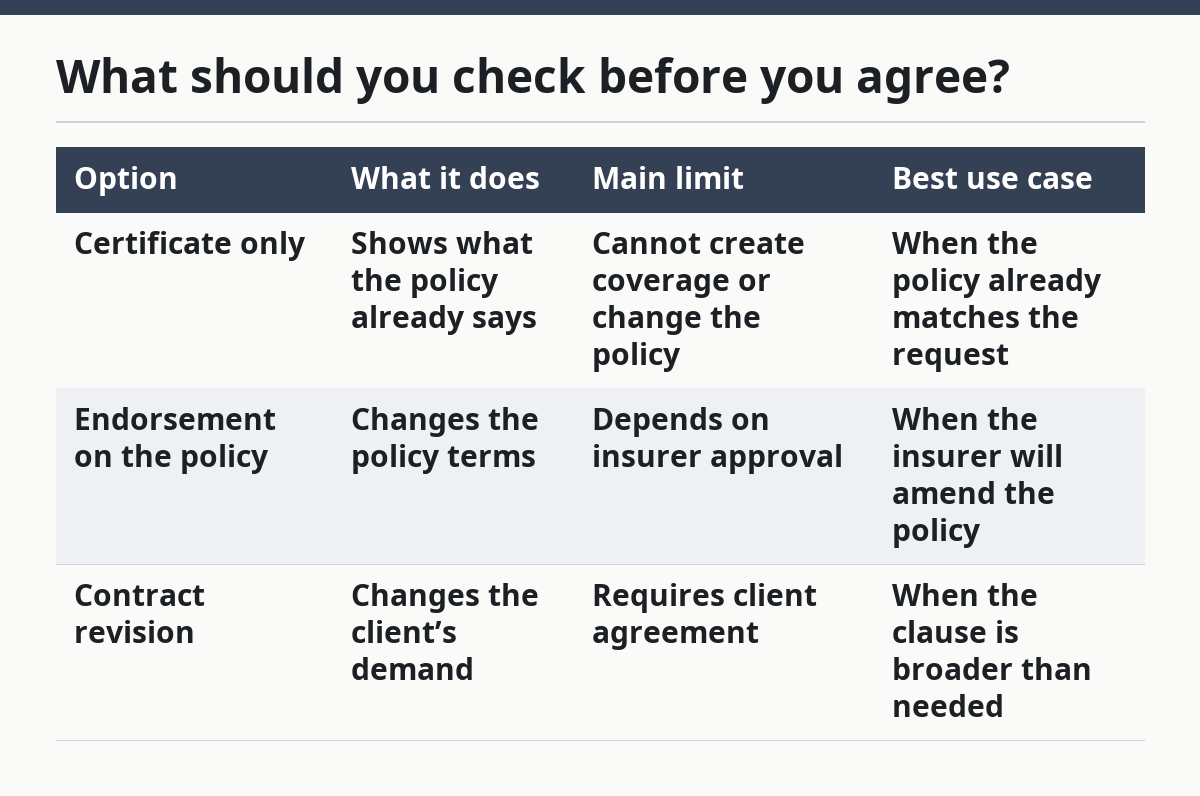
| Option | What it does | Main limit | Best use case |
|---|---|---|---|
| Certificate only | Shows what the policy already says | Cannot create coverage or change the policy | When the policy already matches the request |
| Endorsement on the policy | Changes the policy terms | Depends on insurer approval | When the insurer will amend the policy |
| Contract revision | Changes the client’s demand | Requires client agreement | When the clause is broader than needed |
When should you stop and get help?
You should stop when the request no longer matches the policy or the contract is asking for more than the insurance can lawfully or practically do. These are the situations where pushing ahead on your own can leave the paperwork looking clean while the coverage gap stays real.

The policy does not allow the endorsement: this means the insurer will not write the waiver or primary wording — ask the client to revise the clause or bring in a qualified adviser who can review the risk-transfer language.
The client wants blanket wording for all work, not one project: this means the contract is trying to cover more than the current job — narrow the clause to the specific project or stop until the contract is amended.
The certificate template asks for a statement the policy cannot support: this means the certificate would overstate coverage — do not send it as written; ask the insurer for the proper version or request a contract change.
The clause covers an insurance line you do not carry: this means the client is asking for a form of protection that is not in place — get the contract reviewed before signing, because the gap may not be fixable after the fact.
The insurer’s answer is verbal only: this means there is no written record of approval — do not rely on it, because the next claim handler may not honor a phone call summary.
The contract deadline is shorter than the insurer’s turnaround: this means you may not get the endorsement in time — ask for an extension or a revised clause instead of rushing in with incomplete paperwork.
This is the point where a qualified insurance adviser or contract professional can save time and prevent a bad signature. The wrong choice here is to treat the certificate as a magic fix; if the request is unclear, consult a professional and verify the policy wording with a source such as the Insurance Information Institute.
What mistakes cost freelancers the most?
The biggest mistake is assuming the certificate of insurance controls the deal. It does not. If the policy and endorsement do not match the contract, the certificate only repeats the mismatch in nicer formatting.

Another common error is asking for a waiver after the contract is already signed. That can turn a simple endorsement request into a deadline problem, and some insurers will not backdate policy changes the way a freelancer hopes. The safer alternative is to review the clause before acceptance.
A third mistake is accepting a broad waiver of subrogation without checking the risk. That can remove a recovery path if a client or another third party contributes to a loss. The better move is to limit the wording to the job, the client, or the specific liability line named in the contract.
A fourth error is using the same certificate wording for every client. A one-size-fits-all certificate often fails when one contract asks for primary coverage and another does not. The alternative is to match the certificate and endorsement to the actual contract language each time.
A fifth mistake is ignoring how the contract treats “primary” and “other insurance.” Those words can change how losses are allocated between policies. If the clause is vague or conflicts with the policy, consult a professional and check the wording against a source such as the National Association of Insurance Commissioners before you sign.
What if the wording is broader than your policy?
You should try to narrow the wording to the exact work, the exact client, and the exact coverage line, because broad language is where most trouble starts. If the client contract asks for a waiver of subrogation that applies to every possible claim, the insurer may only approve a narrower version tied to a specific project or relationship.
That is where contract review matters more than a generic certificate. A small wording change can separate an endorsement the insurer will issue from one it will refuse. For example, the difference between “for work under this agreement” and “for all claims arising from any services” can be enough to change the answer.
State and country rules can also affect how these clauses work, and those rules change over time. That is another reason not to treat a template clause as universal; consult a professional if the contract crosses borders, or if the client’s form is much stricter than your policy.
The practical test is simple: if the request cannot be described in one sentence that matches the policy form, it is probably too broad for a quick approval. That does not mean the request is impossible. It means the contract, the endorsement, or both may need redrafting.
How long does this usually take?
It usually takes as long as the contract, the insurer, and the endorsement process take, so there is no honest single timeline to promise. A simple match between the policy and the client’s wording can move quickly; a mismatch that needs a revised clause takes longer.
The result to aim for is not a pretty certificate. It is a file where the contract language, the policy, the endorsement, and the certificate all point to the same coverage story. If those four items line up, the client gets what the contract asked for and you know the insurer has actually supported it.
A weak result looks different. The certificate says one thing, the policy says another, and the contract demands a third. That is the kind of file that passes through email but fails when a claim or audit appears.
For a broader overview of the insurance issues that show up in freelance contracts, the hub page on freelance insurance for client contract requirements is the right next stop.
Can a freelancer agree to a waiver of subrogation request?
Yes, but only if the policy and the endorsement support it. A signature on the contract does not change the insurer’s rights by itself, and a certificate of insurance cannot fix a mismatch later. If the wording is broader than the policy, the safer move is to ask for a narrower clause or written insurer approval.
How do I tell if my policy can add this endorsement?
Check the policy declarations page, the existing endorsements, and the exact form wording, then ask the insurer in writing. The key question is not whether the clause sounds normal; it is whether your policy form allows that change for that client and that line of coverage. If the insurer will not confirm it in writing, treat the request as unresolved and consult a professional.

Is a waiver of subrogation always required by clients?
No, it is not always required, and the wording varies by contract and by industry. Some clients ask for it as part of standard risk transfer, while others never mention it. If the clause appears, the real task is to match it to the policy instead of assuming it must be accepted as written.
Drafted with AI; not yet reviewed by a person.
