

Last updated: November 26, 2026
Quick answer: in most cases, the first 24 hours matter most. For How to Handle a Freelance Missed Deadline Before It Becomes a Claim, start with records, a short client notice, and a new internal date. This is information, not financial advice; for your own situation, speak with a qualified adviser.
Key takeaways
- Act fast, but do not guess. The first job is to capture facts, not to argue fault.
- Keep every message tied to the client email trail and the signed statement of work.
- A short delay can still trigger a claim path if the client says there is loss, extra cost, or formal complaint language.
- A repair plan helps only if it is specific: new dates, owners, and proof of what is still pending.
- If the deadline miss touches a policy notice, reservation of rights, or demand letter, the issue has moved past routine project cleanup.
Who should use this approach?
This approach is for a freelancer who has missed, or is about to miss, a client deadline and needs to reduce the chance that the problem becomes a claim. How to Handle a Freelance Missed Deadline Before It Becomes a Claim assumes you already have the statement of work, the project timeline, and the main client email trail in front of you. It also assumes you can still see what was late, what was blocked, and what the client was promised.
This is not for a situation where the client has already sent a formal demand, a legal notice, or a letter from counsel. Once that happens, the work shifts from project management to incident handling, and the wording of every reply starts to matter in a different way. A deadline miss can look small at first and still carry real money risk if the client says the delay caused lost revenue, extra fees, or a missed launch.
A generic “just apologize” approach fails here. The useful move is to separate three things: what was due, what is late, and what can still be delivered without making the paper trail worse. For that reason, the rest of this guide stays on the response side of the line, not the policy-rewrite side or the claim-classification side. If you also need the larger response map, the hub on freelance claims, incidents, and loss response is the right place to start, and related guidance on professional liability insurance, incident response, and risk management can help frame the next step.
What should I do first?
You should document the delay first and send a short client notice second. The first practical step in How to Handle a Freelance Missed Deadline Before It Becomes a Claim is to build a clean record of the missed date, the reason for the slip, and the current state of the work.
- Open the statement of work and mark the exact deliverable, due date, and acceptance rule. Verify whether the deadline is a hard date, a review date, or a milestone inside a larger project timeline. If the wording is vague, that is a problem because it changes what “late” means.
- Check the client email trail for prior changes, approvals, and blockers. Verify the last agreed instruction, including any scope change that moved the work. If you find a new request buried in email but not in the statement of work, that is a problem because it can hide the real cause of the miss.
- List the delay cause in one sentence and keep it factual. Verify whether the cause is internal, client-driven, or tied to an outside dependency. If the cause is unclear after 10 minutes of review, that is a problem because you cannot fix what you cannot name.
- Write the current status of the deliverable in plain terms. Verify how much is complete, what remains, and which items are blocked. If you cannot say what is left in one or two lines, that is a problem because the repair plan will be too vague to trust.
- Prepare a notice message that names the missed date and the next update date. Verify that it matches the facts in the file and does not guess at outcomes. If the draft blames the client or promises a save you cannot deliver, that is a problem because it can harden the dispute.
- Set a new internal deadline before you reply externally. Verify that the new date is realistic against the remaining hours, review steps, and any third-party input. If the new date is just the old date shifted by a day or two with no workload change, that is a problem because it is not credible.
- Save every document in one folder and keep version names clear. Verify that you have the statement of work, the project timeline, the draft notice, and any supporting files in one place. If files are scattered across inboxes and chat threads, that is a problem because claim review depends on chronology.
The point of this sequence is not drama control. It is evidence control. A clean file helps later if the client raises a complaint, asks for a refund, or says the delay caused a financial loss.
How do I tell the client?
You tell the client with a short notice that gives facts, timing, and the next step. The strongest message is plain, brief, and tied to the agreed timeline, but it should still stay accurate rather than overly absolute.
A useful notice has three parts: what slipped, what remains, and when the next update arrives. If the situation is likely to touch professional liability insurance, add a reservation of rights only if that language belongs in your process and has been reviewed for your own setup. A reservation of rights means you are not giving up any rights or defenses by sending the update, but the phrase should be used carefully because it can escalate tone fast.
Use the client email trail rather than a phone call alone. A call can help calm the exchange, but it leaves no record unless you follow up in writing within the same day. If you do talk by phone, send a recap email that repeats the date, the deliverable, and the next check-in. That written recap is the part that matters later. For general recordkeeping standards, see the U.S. Federal Trade Commission’s guidance on maintaining accurate business records: https://www.ftc.gov/business-guidance/resources/keeping-your-business-records-accurate
Do not overload the note with excuses. A client wants to know whether the work is still alive, whether the date has moved, and whether the new plan is believable. If you cannot give a firm new date, say when you will give the next update instead. That is not ideal, but a clear update point is better than a false promise.
What counts as a claim trigger?
A claim trigger starts when the delay stops being a project problem and starts looking like a demand for money, correction, or formal dispute handling. That shift can happen before any lawsuit exists.
The table below shows common signs and what they usually mean in a deadline miss incident response.
| Signal in the file | What it usually means | Why it matters |
|---|---|---|
| Simple status request | The issue is still operational | You may still fix it inside the project timeline |
| Repeated complaint emails over 1-2 days | The client is building a record | The client email trail is becoming evidence |
| Demand for refund, discount, or replacement work | The client is linking delay to money | Loss language may follow |
| Mention of counsel, insurer, or formal notice | The issue is moving toward a claim path | Handling rules may change at once |
| Written reservation of rights from your side | The file is being treated as sensitive | The wording now matters as much as the work |
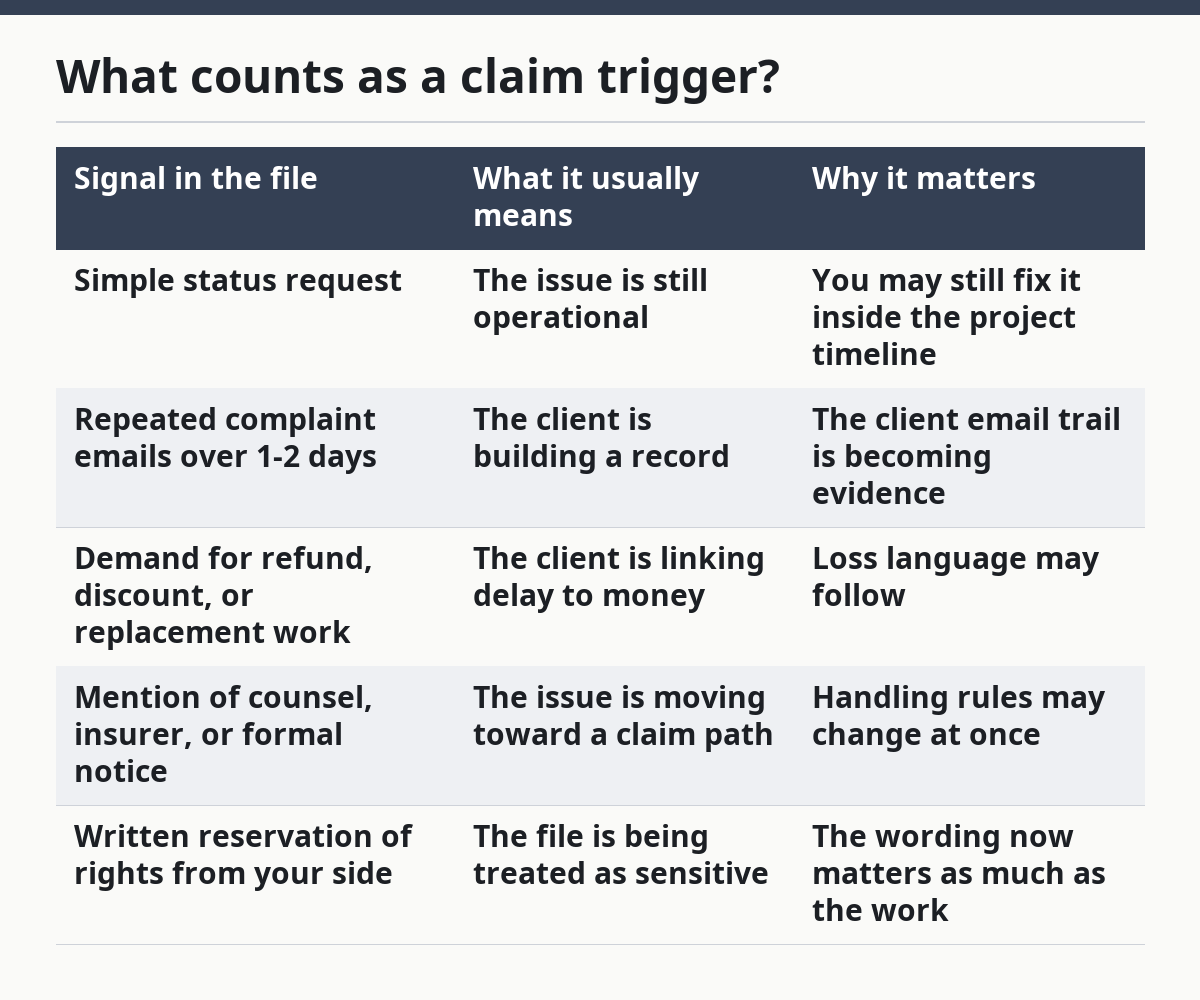
A missed deadline is not automatically a claim, but it can become one if the client says the delay caused harm or if the exchange starts to look formal. If you are unsure, consult a qualified professional and check the client’s policy or contract terms; the Insurance Information Institute explains that claim handling depends on the facts and the policy language: https://www.iii.org/article/claims-made-vs-occurrence-policies. The practical question is not “Is this bad?” The practical question is “Has the file crossed from project correction into dispute language?” That line can move fast.
If the issue is still small, keep the response narrow. If the client is already asking for compensation, the file needs more care because professional liability insurance often turns on notice timing and the exact wording used in the first written exchange. That is why a casual apology thread is risky when the facts are not stable.
What should I check before going further?
You should check the scope, the dates, the proof, and the risk of further delay before you promise anything else. Four checks matter most.
First, compare the missed item against the statement of work. If the deliverable changed and nobody updated the paper, the file may contain an old deadline that no longer reflects the work. Second, check the project timeline for downstream dates. A delay that blocks a launch, handoff, or approval can create a bigger problem than the missed task itself.
Third, check for missing inputs. A lot of deadline trouble comes from waiting on assets, approvals, or access that were never delivered on time. Fourth, check whether the next action is still under your control. If you need client input, say so in writing. If you need outside help, note the dependency and the date you need it by.
A good result looks modest. The client knows the status, the file shows the date change, and the next step is written down. A bad result is a long apology with no new date, no record, and no proof of what blocked the work.
When should I stop and get help?
You should stop using a normal project-fix approach when the file shows signs of formal dispute, repeated loss language, or a policy issue. The right move is to slow down and bring in qualified help for the next step, not to improvise.

The client has asked for compensation: That means the issue is no longer only about delivery — it has a money claim shape. Stop casual negotiation and document the request before replying.
A demand letter or legal notice arrives: That is a formal step, not a routine complaint. Stop ad hoc emails and follow the process tied to your professional liability insurance and legal guidance.
The delay may affect a third party: That means the harm may not be limited to the client relationship. Stop guessing about exposure and preserve every record tied to the statement of work and timeline.
You do not know whether the facts are complete: That means the file may change again, which can make a rushed reply inaccurate. Stop and gather the missing documents before you send more words.
The client starts quoting clauses or deadlines back at you: That means the discussion has turned contractual. Stop informal talk and make sure every response matches the written record.
This is also the point to involve a qualified adviser for your own situation. Money, contract, and insurance issues change with country, contract language, and policy terms, so a one-size reply can cause more damage than the missed deadline itself. For contract basics and written commitments, the U.S. Small Business Administration is a useful external starting point: https://www.sba.gov/business-guide/launch-your-business/write-your-business-plan and https://www.sba.gov/business-guide/plan-your-business/choose-your-business-structure
What mistakes make this worse?
The biggest mistakes are silence, loose language, and bad record keeping. Each one can turn a fixable delay into a harder claim file in How to Handle a Freelance Missed Deadline Before It Becomes a Claim.

- Waiting too long to send notice. The client sees the gap before they see your plan. The better alternative is a same-day or next-business-day written update once the facts are clear enough to state.
- Sending a long explanation with no new date. The client gets noise, not action. The better alternative is one short notice, one new target, and one next update date.
- Relying on chat instead of email. Chat messages get buried and broken into fragments. The better alternative is to mirror the key point in the client email trail.
- Changing the story after each reply. Inconsistent facts make the file look unreliable. The better alternative is to align the statement of work, the project timeline, and the status note before you send anything else.
- Fixing the work without saving proof. You may solve the task and still lose the record. The better alternative is to save versions, approvals, and timestamps as you go.
- Using blame-heavy language. Even if the delay had a real cause, sharp language can harden the dispute. The better alternative is factual wording that states what happened and what happens next.
How does this change if the deadline miss is messy?
It changes when the work had scope creep, shared dependencies, or multiple missed dates. In those cases, a normal one-paragraph apology is not enough, because the real issue may be a chain of slips rather than a single late deliverable.
If the statement of work is thin, lean harder on the client email trail and the latest written approval. If several dates have moved, list them in order so the record shows the pattern instead of a blur. If the missed deadline came after a client change request, keep the old and new scope separate. That matters because the cause of the delay may be mixed, and mixed facts are where weak files start.
A final edge case is the overnight fix. If you can still recover the deadline within 24 hours, the response may stay inside project management. If the repair needs several days, money, or a formal extension, the file is already in a more serious lane.
What does a good outcome look like?
A good outcome looks like a repaired file, not just a finished task. The client has a clear status update, the timeline is documented, and the next step is written where both sides can see it.
The strongest sign is that the problem stays contained. The client may still be unhappy, but the exchange stays factual, the record stays clean, and the issue does not jump early into formal claim language. In that sense, the goal is not to make the delay disappear. The goal is to keep the missed deadline from becoming a bigger loss than it already is.
FAQ
Is a missed deadline always an insurance claim?
No. A missed deadline is often just a project problem at first, and many files never become claims. It becomes more serious when the client says the delay caused harm, asks for money, or sends formal dispute language. The point is to watch the file closely and seek professional guidance if the facts start to change.
What should I document after a delay?
Document the due date, the current status, the cause of the delay, and every message tied to the project timeline. Save the statement of work, the client email trail, and any proof of approvals or blockers. Keep the record factual and time-ordered so later review is easier.
Should I tell the client right away?
Yes, once you know the facts well enough to state them cleanly. A prompt written notice usually helps more than silence because it keeps the issue inside the project record instead of letting the client build their own version. If you cannot give a firm fix yet, say when the next update will come.
What if the client is already angry?
Stay brief, factual, and consistent. Repeat the current status, the new update date, and the next action you will take. If the language turns into a demand, stop improvising and get qualified help.
What if the delay was partly the client’s fault?
Keep that point in the record, but do not turn the reply into a blame fight. State the missing input or approval, note the date it was needed, and move back to the repair plan.
Drafted with AI; not yet reviewed by a person.
