

Last updated: November 23, 2026
Quick answer: when a material change happens, review 3 things — your contract, your insurance, and your records. Freelance Business Changes and Policy Updates matter when they change your risk, your taxes, your client terms, or your insurance paperwork. The smartest move is to review your business setup at the moment something material changes — a new service, a new contract type, a new address, a bigger client, or a shift in income — because that is when old policies stop fitting the work.
A guide like this needs a practical lens. For a freelancer, “policy update” can mean a contract clause, a tax rule, a platform policy, or an insurance change, and the wrong update can create a claim gap or a compliance problem.
Key takeaways
- A business change matters when it alters what you do, who you do it for, or how money moves.
- Do not wait for an annual review if you have changed services, locations, or client terms.
- Keeping old insurance limits, old contract language, and old tax records after the business has changed can create trouble.
- Some updates are routine housekeeping; others change your exposure enough to need legal, tax, or insurance advice.
- A simple system helps: flag the change, compare it against your policies, then update the records that actually control risk.
What counts as a business change?
A business change counts when it changes your work, your money, or your exposure to a claim. That can be as small as moving from solo copywriting to managing ad accounts, or as big as adding subcontractors, hiring staff, or registering a formal business name.
Changes that seem routine may still matter. A new client in a regulated industry, a new country, a different payment model, or a move from project fees to retainer work can all change the policy rules that apply to you. A freelancer who keeps the same website but starts handling customer data now has a different risk profile than the one who only wrote blog posts.
The same logic applies to the paperwork around the business. A new address can affect notices and tax records. A new bank account can affect bookkeeping categories. A new service can affect whether your current professional liability policy actually matches the work you now sell. If a change affects what a claim would look like, it deserves a review.
The basic test is simple, but if you are unsure, consult a qualified accountant, lawyer, or insurance broker before treating it as harmless. For general starting points, see the IRS self-employed tax center and GOV.UK’s guidance for working for yourself.
IRS: https://www.irs.gov/businesses/small-businesses-self-employed/self-employed-individuals-tax-center
GOV.UK: https://www.gov.uk/working-for-yourself
Which updates change your risk the most?
The updates that change your risk the most are the ones that affect scope, money flow, data handling, and legal status. Those four areas drive most of the painful surprises for freelancers because they sit at the center of contracts, insurance, and tax filings.
A service change is one of the biggest triggers. If you move from writing to strategy, from design to development, or from advice to implementation, the claim type changes too. A client dispute that used to be about style can become a dispute about missed deadlines, data handling, or business interruption. That is why a policy that fit one service line can become weak on the next one.
A payment change matters just as much. Switching from one-off invoices to retainers, milestone billing, or subscription-style work changes cash flow and can change how you manage reserve money for tax and expenses. It also changes how easy it is for a client to argue over deliverables, since the payment structure often shapes the contract itself.
A data change is another major trigger. If you start storing client files, contact lists, payment details, or login access, you have created a different kind of exposure. That does not automatically mean you need every policy available, but it does mean you should check whether your current cover and contracts mention confidentiality, data breach handling, and third-party access.
A legal-status change is the one many freelancers leave too late. A sole trader, a single-member company, and a partnership do not all face the same paperwork or tax treatment, so consult a professional if your setup changes. The business form affects who signs the contract, who pays the tax, and who gets named in a dispute. The wrong assumption here can cause a simple admin update to become a legal mess.
Here are the changes that deserve a fast review:
- new service line
- higher-value client
- new country or region
- different contract structure
- subcontractor or staff hire
- new software handling client data
- change in business name or legal entity
- change in address or banking details
A freelancer does not need to panic over every small tweak. But if a change affects the answer to “who is responsible, who is paying, and what could go wrong,” it needs action.
How do policy updates affect freelancers?
Policy updates affect freelancers by changing the rules you follow and the proof you keep. A policy update can come from a platform, a client, an insurer, a tax body, or your own contract template, and each one can change what happens if there is a dispute.
Platform policy changes are often the quietest but most annoying. A marketplace can change payout timing, dispute windows, account suspension rules, or content restrictions with little warning. If you depend on that platform for income, even a small wording change can affect how long you wait to get paid or how you challenge a chargeback.
Client policy changes matter too. Large clients often update vendor onboarding, security questionnaires, invoicing rules, and insurance requirements. A freelancer who ignores those changes can lose a contract before any work starts. In some cases, the client’s policy update is really a contract update in disguise.
Insurance policy updates are where many freelancers make their biggest mistake. A policy renewal is not a formality if your business has changed. A coverage limit that made sense at low revenue may not fit a larger contract. A policy that excluded a certain service last year may still exclude it now unless you ask for a change. Read the wording, not the sales copy.
Tax and compliance updates matter because they can change deadlines, recordkeeping, and what counts as deductible expense. The IRS self-employed tax center and GOV.UK’s self-employed guidance both exist for a reason: the rules around business income, expenses, and records are not static. For a general starting point, see the IRS self-employed tax center and GOV.UK’s guidance for working for yourself.
IRS: https://www.irs.gov/businesses/small-businesses-self-employed/self-employed-individuals-tax-center
GOV.UK: https://www.gov.uk/working-for-yourself
The hidden problem is that policy updates often arrive one piece at a time. A freelancer may update an invoice template but forget the insurance certificate. Or update a contract clause but forget the data retention policy. The fix is to treat every policy update as part of a system, not an isolated task, and if the change is not straightforward, consult a professional.
DIY updates or professional help?
DIY updates win for small, simple freelance businesses; professional help wins when the change affects liability, tax, or contract risk. The right choice depends on how much changed, how much is at stake, and whether you can identify the downstream effects without guesswork.
The DIY path works when the business is still simple. If you are a solo freelancer with one main service, no subcontractors, a small number of clients, and no regulated data, you can usually handle routine updates yourself. That means updating your invoice details, checking your contract template, reviewing your policy renewal, and confirming that your records match the new reality.
The weakness of DIY is obvious: it only works if you know what to look for. A freelancer can update a website and miss an insurance exclusion. They can change their trading name and forget to update the bank records. They can sign a bigger client contract and fail to notice a warranty clause that goes beyond their policy terms. The cost of a missed detail is often far higher than the cost of a review.
Professional help is the safer move when the change touches multiple rules at once. A lawyer is useful when the contract language changed. An accountant is useful when the tax treatment changed. An insurance broker or specialist is useful when the policy wording and the work no longer match. The point is not to outsource everything; the point is to avoid guessing where the risk is highest. For a broader step-by-step checklist, see the freelance contract checklist, freelancer tax guide, and freelancer insurance guide.
| Criteria | DIY update | Professional help | Winner for this condition |
|---|---|---|---|
| Cost of review | Low cash outlay | Higher cash outlay | DIY when the change is small |
| Speed | Fast if the change is simple | Slower because of back-and-forth | DIY for routine admin |
| Risk of missed detail | Higher | Lower | Professional help for complex changes |
| Best for contract wording | Basic edits only | Better for liability language | Professional help when client terms changed |
| Best for tax treatment | Simple record updates | Better when structure changed | Professional help after entity or income changes |
| Best for insurance fit | Renewal check only | Better when services expanded | Professional help when scope changed |
| Best for platform policy changes | Manual review | Rarely needed | DIY for single-platform updates |
| Best for data/privacy issues | Limited | Stronger support | Professional help for data-heavy work |
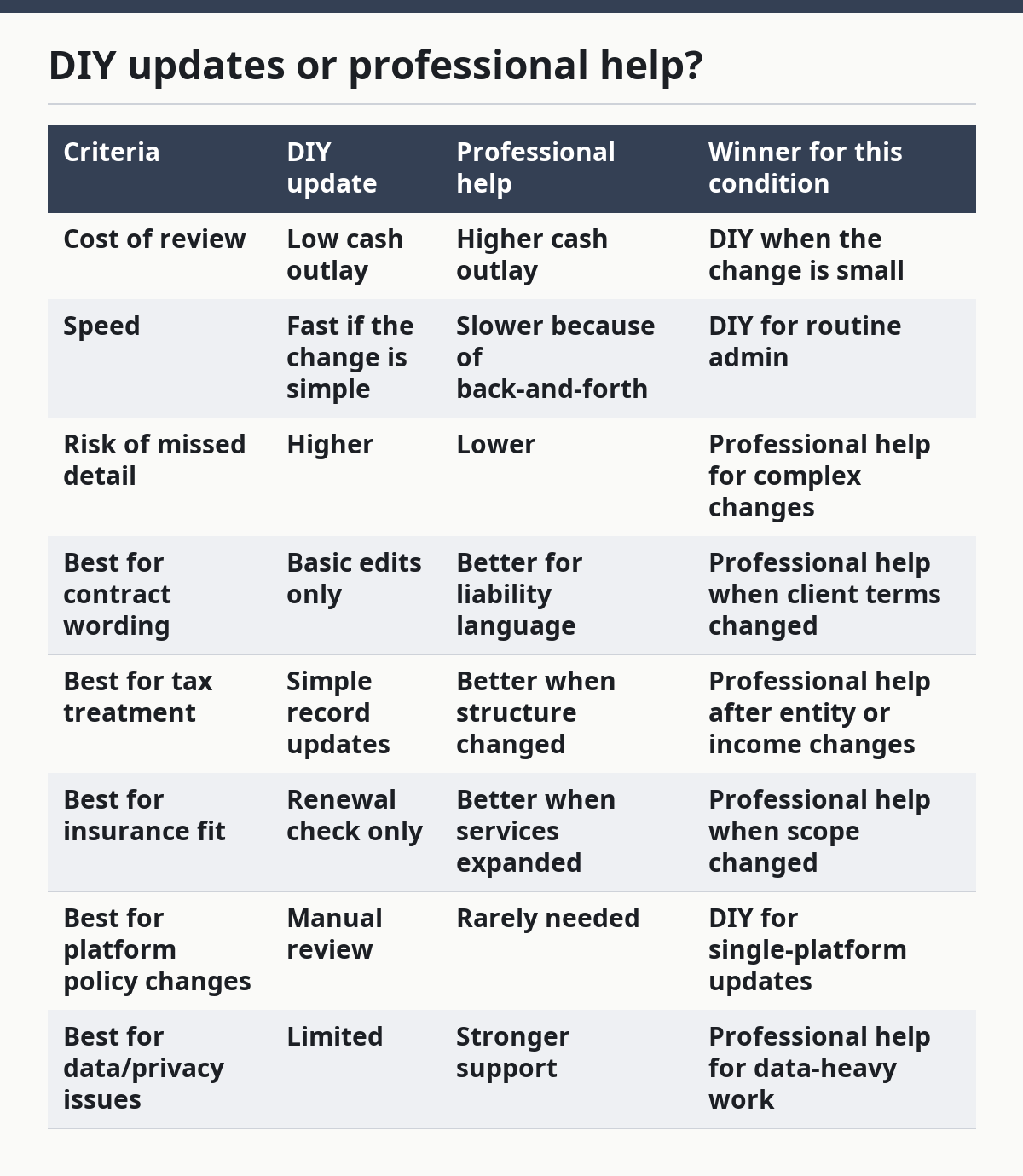
The right recommendation is plain: choose DIY only when the change is narrow and your current setup still fits the work. Choose professional help when the change touches contracts, tax, or insurance at the same time. Neither path is right if you are trying to save a little time while risking a much bigger claim later.
What should change in your insurance?
Your insurance should change when your work, client size, or exposure changes. The main question is not whether you have a policy already; it is whether the policy still matches what you actually do today.
A freelancer often starts with one basic cover and assumes it will keep working forever. That assumption is weak. If you add consulting, handling client data, working on-site, or subcontracting pieces of the job, the risk pattern changes. A policy that once fit a solo writer may not fit a freelancer who now advises on business decisions or handles sensitive material.
Check the parts of the policy that control the real outcome, not the marketing terms. Look at what activities are covered, whether your legal name and business name are correct, whether any client sectors are excluded, and whether the policy treats subcontractors as part of the work. If the policy says one thing and the proposal says another, get that cleared up before renewal.
You should also watch the limits and the excess. A bigger contract can make a small limit feel thin very quickly. A higher excess can make a claim expensive even if the policy technically responds. That matters because a freelancer’s cash reserves are usually not built to absorb a claim plus a long dispute.
The biggest mistake is assuming that “freelance business” is one category. It is not. A designer, consultant, developer, photographer, marketer, and virtual assistant can all have very different exposure. The cover should match the task, not the label.
A practical insurance review should ask:
- Has the service list changed?
- Has annual turnover shifted enough to affect the policy?
- Are subcontractors or assistants now involved?
- Is client data stored, processed, or shared?
- Are contracts asking for wider indemnity terms?
- Is the policy still issued in the correct legal name?
If the answer to any of those is yes, the policy needs a look. For readers focused on freelancer liability insurance, that is the point where a policy review stops being admin and becomes risk control. See also the professional liability insurance guide and small business insurance checklist.
What records should you update first?
The first records to update are the ones that affect money, identity, and claims. That order matters because the most common problems start when a freelancer updates one system but leaves another behind.
Start with the legal and tax records. If the business name, entity type, address, or bank details changed, fix those first. The tax office, insurer, and major clients should all see the same business identity. If they do not, a payment can stall, a notice can go missing, or a policy endorsement can fail to match the actual business.
Next, update the contract template. A freelancer’s contract should match the current service, not last quarter’s service. If you now include strategy calls, data access, or revision rounds, the contract should say so. If the business changed from fixed-fee work to monthly retainers, the payment language should change too.
Then update the insurance file. Keep the current policy schedule, renewal date, declarations page, and any endorsements in one place. That helps you spot when a client asks for proof of cover and the document on file is already out of date. It also helps when you need to compare old and new wording before agreeing to a new job.
After that, update the operational systems: invoicing, bookkeeping categories, client onboarding forms, and password or access records. These are easy to forget because they feel like admin rather than policy. But they are the place where bad data often turns into bad decisions.
A simple order of operations works better than trying to fix everything at once:
- legal and tax identity
- client contract template
- insurance records
- bookkeeping and invoicing
- website and client-facing bios
- internal checklists and storage rules
That sequence reduces the chance of mismatch. It also keeps the business from looking one way on a proposal and another way in the paperwork. For practical tools, see the freelance bookkeeping guide and client onboarding checklist.
Which updates are easy to miss?
The easy-to-miss updates are the ones that do not feel urgent. A freelancer usually notices a new contract value, but may ignore a tiny policy wording change or a quiet platform rule update until it causes trouble.
One easy miss is the service description. Freelancers often keep using the same short bio or website copy long after the real offer has changed. That can confuse clients, but it can also matter for insurance if the policy was written for a narrower service list. If your public description now promises more than your contract and policy cover, that mismatch is a risk.
Another easy miss is the subcontractor question. Many freelancers bring in help for one project and assume it is informal enough not to matter. That assumption can fail fast if the subcontractor handles client material, meets deadlines for you, or creates work that you are still responsible for. The contract and insurance should reflect that arrangement.
A third easy miss is the location update. A home office move may seem minor, but address changes can affect notices, tax records, and business registration details. Even a move within the same city can matter if it changes where records are kept or how client property is stored. The risk is not the move itself; it is the stale paperwork that follows it.
Platform policy updates are also easy to miss because they arrive in dashboards and email notices that people skim. If you sell through a marketplace, check the payment, dispute, and content rules regularly. A small wording change can alter how a dispute is handled or how quickly funds are released.
The final easy miss is the renewal date. Renewal is where many freelancers assume nothing changed because the policy was active last year. That is backwards. Renewal is exactly when the insurer expects the current facts, not the old ones. If turnover, services, client type, or address changed, renewal is the place to correct it.
When should you stop and get advice?
You should stop and get advice when the change affects liability, tax structure, or a client contract that you cannot easily explain in one sentence. That is the point where guesswork becomes expensive.
If a new contract asks for special indemnity terms, broad warranties, or unusual ownership rights, get the language reviewed before signing. Those clauses can shift risk in ways a freelancer may not spot on first read. A quick yes can create a long problem.
If your business structure changed, get advice before filing or renewing anything based on the old setup. A sole trader and a company do not move through the system the same way. The same applies if you are adding partners or moving to a setup that involves shared control, shared profit, or shared responsibility.
If the work now involves regulated sectors, sensitive data, or client systems, stop and check the policy and contract language together. That matters because the weakest link often sits in the gap between the legal agreement and the insurance wording. A client may expect one thing while the policy covers something narrower.
If you are unsure whether the change is material, use a simple rule: when the answer affects who can be sued, who gets paid, or who bears the loss, advice is warranted. That is true even if the change feels “small” from the freelancer’s side.
If you are balancing cost against risk, a short review is usually cheaper than a rejected claim, a tax filing problem, or a client dispute after the fact.
What should change first in a busy freelance business?
The first change should be the one that protects you from the biggest loss. For most freelancers, that means aligning the contract, insurance, and tax records before touching cosmetic updates like a logo or website refresh.
If the business is still small, start with the contract and insurance file. Those two documents decide what you promised and what is covered if the job goes wrong. A new brand color does not matter nearly as much as a missing exclusion or an outdated scope clause.
If cash flow changed, update the invoicing and bookkeeping system next. That is especially important when you move from simple invoices to deposits, monthly retainers, or staged billing. The system should show when money is due, what it is for, and how it maps to income records.
If the business now handles more client information, update storage and access controls early. That includes who can open files, where files live, and how long they are kept. The less guesswork there is, the lower the chance of an avoidable dispute.
If you only have time for one review this month, make it the one that touches the most exposed work. That usually means the contract and insurance first, then the tax and bookkeeping records, then the public-facing pages. The outside brand can wait a week; the internal risk controls should not.
What does a good update process look like?
A good update process is short, repeatable, and tied to real events. It does not rely on memory, and it does not wait for chaos.
The process should begin with a trigger list. Common triggers include a new service, a higher-value client, a move, a new payment model, a legal-entity change, and a new data-handling task. If one of those happens, the review starts immediately instead of at the end of the quarter.
Next comes a three-part check: contract, insurance, records. The contract says what you promised. The insurance says what risks are covered. The records say what the business actually is. When those three match, the system is usually in decent shape.
Then comes the sign-off step. Before a big client job starts, confirm that the business name, address, service scope, and policy details are still accurate. If a change is material, document it. A short note with the date and reason is often enough to show that the update was deliberate, not careless.
Finally, keep a simple annual review even if nothing major changed. Renewal is the natural checkpoint for freelancers because it catches drift. A business can change slowly without anyone noticing, and the annual review is where that drift gets corrected.
A good system does not need to be fancy. It just needs to make sure that when the business changes, the policies change with it.
Which approach is the right one?
The right approach is to update early and keep the business records aligned with the real work. A freelancer who waits for a problem will almost always have less room to fix it.
Choose DIY updates if the business is still simple, the contract is standard, the insurance terms are familiar, and the change is narrow. Choose professional help if the change affects liability, tax structure, or a client clause that could shift risk. Choose neither if the business has changed so much that the old setup no longer resembles the work you are selling.
The sharpest rule is this: if the change can affect a claim, a payment, or a filing, do not leave it sitting in an old template. That advice is simple, but it prevents many of the mistakes freelancers make when they grow faster than their paperwork.
FAQ
How often should a freelancer review policy updates?
A freelancer should review policy updates any time a material business change happens, and again at renewal. That usually means more than once a year if the work is changing quickly. A new client type, service, or location should trigger a fresh look even if the renewal is months away.
Do small business changes really matter?
Yes, small changes can matter when they affect risk or paperwork. A new service line, new payment model, or new data-handling step can change what your contract says and what your insurance should cover. The size of the change is less important than the size of the consequence.
What is the biggest mistake freelancers make with policy updates?
The biggest mistake is updating one part of the business and leaving the rest unchanged. A freelancer may change their website, but not their contract, insurance, or tax records. That mismatch can create disputes, rejected claims, or filing errors.
When should I ask for help instead of doing it myself?
Ask for help when the change affects liability, tax treatment, or contract wording you do not fully understand. That is especially true if the business structure changed, the client wants unusual terms, or the work now involves sensitive data. A short review is usually cheaper than fixing a mistake later.
Do I need to change my insurance every time I change clients?
Not every time, but you should check it when the new client changes the risk. A larger contract, stricter indemnity clause, regulated sector, or different service scope can justify an update. The key question is whether the policy still matches the work, not whether the client name is new.
Drafted with AI; not yet reviewed by a person.
